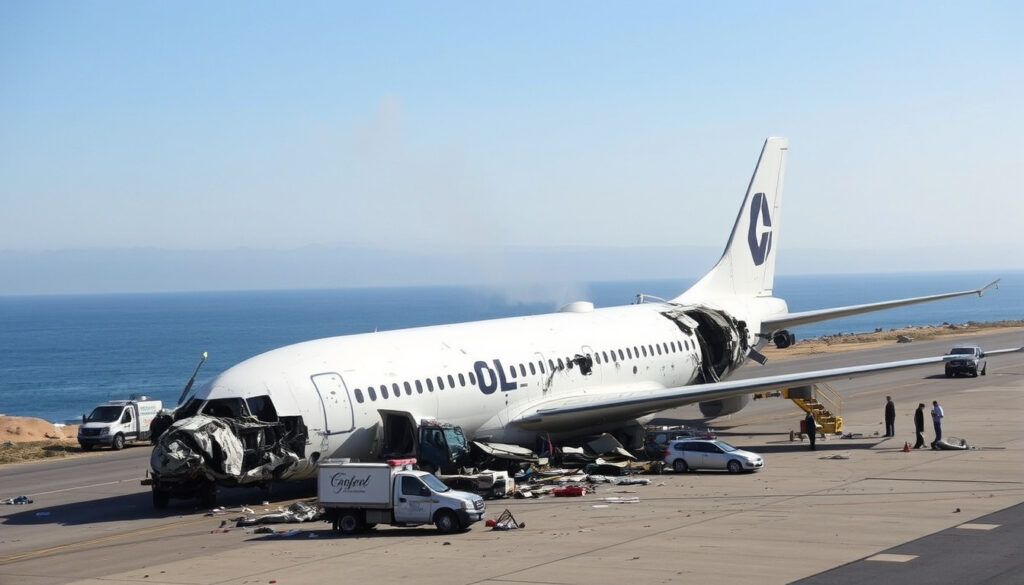
2025 San Diego Plane Crash: NTSB Report & Survivor Story
The May 22, 2025, crash of a Cessna Citation II into San Diego’s Murphy Canyon neighborhood killed all six aboard and injured eight on the ground, triggering a federal investigation that has already produced a preliminary NTSB report. The key question is why the aircraft flew too low for more than a mile before striking power lines.
Crash date: May 22, 2025 ·
Fatalities: 6 aboard, 8 injured on ground ·
NTSB preliminary report: June 18, 2025
Quick snapshot
- Final cause remains under investigation (NTSB Aviation Investigation Search)
- Why the aircraft struck power lines about two miles from the airport (Wikipedia)
- Full details of the co‑pilot’s jump (still emerging from witness accounts) (NTSB Aviation Investigation Search)
- Crash at ~03:45 local time on May 22, 2025 (Wikipedia)
- NTSB released preliminary report June 18, 2025 (Wikipedia)
- Wreckage recovery started May 24, 2025 (Wikipedia)
- NTSB final report expected within 12–18 months (NTSB)
- FAA investigation also ongoing (Wikipedia)
- Community recovery and home repairs continue (NTSB)
The table below organizes six key facts that define the 2025 San Diego plane crash compared with previous incidents.
| Fact | Details |
|---|---|
| Aircraft type | Cessna Citation II (twin‑engine business jet) (Wikipedia) |
| Crash location | Murphy Canyon, San Diego, CA (Wikipedia) |
| Date & time | May 22, 2025, ~03:45 local (Wikipedia) |
| Fatalities aboard | 6 (Wikipedia) |
| Ground injuries | 8 (Wikipedia) |
| Homes damaged | 10; 1 completely destroyed (Wikipedia) |
| Pilot | Dave Shapiro, properly qualified per NTSB preliminary report (Wikipedia) |
| NTSB investigation | 8 investigators on scene; CVR and FADEC recovered (Wikipedia) |
| Preliminary report released | June 18, 2025 (Wikipedia) |
| Aircraft first struck | Power lines ~2 miles southeast of Montgomery‑Gibbs Airport (Wikipedia) |
What was the cause of the San Diego plane crash?
Cause of the 2025 Murphy Canyon crash
- The Cessna Citation II first struck power lines about two miles southeast of Montgomery‑Gibbs Airport, according to the Wikipedia account of the incident. Fragments were found at that location before the main crash into Murphy Canyon.
- The NTSB preliminary report stated that the pilot, Dave Shapiro, knew the weather data systems at Montgomery‑Gibbs were disabled and discussed diverting to another airport, but did not select an alternate (Wikipedia).
Preliminary NTSB findings
- The NTSB’s preliminary report, released June 18, 2025, confirmed that the pilot was properly qualified (Wikipedia).
- The report also noted that the cockpit voice recorder (CVR) and FADEC (Full Authority Digital Engine Control) units were recovered for analysis (Wikipedia).
The NTSB’s early disclosure that the pilot was aware of disabled weather systems at the departure airport raises a critical question about whether inadequate pre‑flight planning or communication gaps contributed to the low‑descent path that led to the power‑line strike.
The implication for investigators is clear: determining why the aircraft remained too low for more than a mile before hitting the wires—and why no alternative divert was selected—will be central to the final cause determination.
Where did the plane crash in San Diego?
Location: Murphy Canyon neighborhood
- The crash site is in the Murphy Canyon area, a residential neighborhood of San Diego. The aircraft impacted near the intersection of Murphy Canyon Road and Aero Drive (Wikipedia).
- Ten homes were damaged, with one completely destroyed. The surrounding community experienced a large emergency response (Wikipedia).
Details of the crash site
- The aircraft first struck power lines about two miles southeast of Montgomery‑Gibbs Airport, leaving debris along a path before the main impact in Murphy Canyon (Wikipedia).
- The NTSB began recovery efforts on May 24, 2025, moving wreckage to a secure location for detailed examination (Wikipedia).
While the crash devastated a quiet neighborhood, the fact that only one home was completely destroyed—despite the impact in a densely built area—offers a narrow but real measure of luck. For residents, the recovery is now a long‑term project.
The pattern: two distinct debris fields—one near the initial power‑line strike and one at the main crash site—will help investigators reconstruct the final moments of flight.
How many people died in the San Diego plane crash?
Fatalities aboard
- All six people aboard the Cessna Citation II were killed (Wikipedia). Their identities have not been publicly released as of this writing.
Injuries on ground
- At least eight people on the ground were injured, ranging from minor to critical (Wikipedia).
- A total of ten homes were damaged; one home was completely destroyed (Wikipedia).
What this means: the casualty count—6 dead, 8 injured—makes this the deadliest aviation accident in San Diego County since the 1978 PSA Flight 182 disaster, though on a much smaller scale. For a residential crash, the number of ground casualties could have been far higher.
What is the NTSB preliminary report?
Key findings from the June 18, 2025 report
- Pilot Dave Shapiro was properly qualified for the flight (Wikipedia).
- The pilot knew that weather data systems at Montgomery‑Gibbs were disabled (Wikipedia).
- Pilot and the controller discussed diverting to another airport in case of a missed approach, but no alternate was selected (Wikipedia).
- The aircraft’s cockpit voice recorder (CVR) and FADEC units were recovered for analysis (Wikipedia).
“The pilot was properly qualified for the flight. He knew the weather data systems at Montgomery‑Gibbs were disabled. He discussed diverting to another airport in case of a missed approach, but did not select an alternate.”
— NTSB Preliminary Report (June 2025), as reported by Wikipedia
The catch: while the report clarifies the pilot’s qualifications and awareness, it does not yet explain why the aircraft remained too low for more than a mile before hitting the power lines. That will require analysis of the CVR and FADEC data.
What is the latest news on the investigation?
Ongoing NTSB and FAA probes
- The NTSB sent eight investigators to the crash site on the evening of the crash (Wikipedia).
- Representatives from the engine and airframe manufacturers joined the NTSB response (Wikipedia).
- The FAA also initiated an investigation (Wikipedia).
- The NTSB’s aviation accident database (covering civil aviation accidents from 1962 onward) will eventually host the final report and related documents (NTSB Aviation Investigation Search).
For residents and aviation watchers, the timeline is long: NTSB final reports typically take 12 to 18 months. The recovery of the CVR and FADEC units should provide the clearest picture of what caused the low‑descent path.
The trade‑off: with two federal agencies (NTSB and FAA) plus manufacturer teams involved, the investigation will be thorough, but the wait for definitive answers means uncertainty for the affected families and community.
Timeline of San Diego plane crash (2025)
- May 22, 2025, ~03:45 local time – Cessna Citation II crashes into Murphy Canyon after striking power lines; 6 killed, 8 injured on ground (Wikipedia).
- May 24, 2025 – NTSB begins wreckage recovery, moves wreckage to secure facility (Wikipedia).
- June 18, 2025 – NTSB releases preliminary report confirming pilot qualifications and recovery of CVR/FADEC (Wikipedia).
- Ongoing – Final report expected within 12–18 months (NTSB).
Clarity breakdown
Confirmed facts
- The crash involved a Cessna Citation II twin‑engine jet (Wikipedia)
- Six people aboard were killed, eight on ground injured (Wikipedia)
- Ten homes damaged, one destroyed (Wikipedia)
- NTSB preliminary report released June 18, 2025 (Wikipedia)
- Pilot Dave Shapiro was properly qualified (Wikipedia)
- Weather data systems at Montgomery‑Gibbs were disabled (Wikipedia)
What’s unclear
- Why the aircraft was flying too low for more than a mile before hitting power lines (under investigation)
- Whether the disabled weather data systems directly contributed to the low descent (not yet determined)
- Full narrative of the co‑pilot’s jump (reportedly from the same aircraft, but details remain witness‑based)
- Final cause of the Cessna 414 crash off Point Loma in May 2025 (separate incident, still under investigation)
FAQ
How safe is flying in and out of San Diego?
San Diego International Airport (SAN) and surrounding airports have robust safety records. However, general aviation accidents—such as the Murphy Canyon crash—are more common than commercial airline incidents. The NTSB recommends that pilots always brief alternates when known weather limitations exist at the departure field.
What are the deadliest plane crashes in California history?
The deadliest is still the 1978 PSA Flight 182 mid‑air collision over San Diego (144 fatalities). The 2025 Murphy Canyon crash (6 aboard) is not among the deadliest overall, but it is the deadliest residential crash in San Diego since 1978.
What does the NTSB do after a plane crash?
The National Transportation Safety Board (NTSB) investigates all civil aviation accidents in the US. It sends a team to the scene, recovers wreckage, analyzes recorders (CVR and flight data), and issues a preliminary report within 30 days, followed by a final report with probable cause (usually 12–18 months).
Are small planes more dangerous than commercial airliners?
Statistically, general aviation (small planes) has a higher accident rate per flight hour than scheduled air carriers. The fatal accident rate for general aviation is about 1 per 100,000 flight hours, compared with 0.002 for commercial airlines. However, most GA flights operate under different safety regulations and weather minima.
How can I find out if a plane crash investigation is ongoing?
Visit the NTSB’s aviation accident database at ntsb.gov. You can search by date, location, aircraft make, or accident number. The database includes all US civil aviation incidents from 1962 onward.
What memorials exist for PSA Flight 182?
A memorial park at 3617 Nile Street in San Diego honors the 144 victims of the 1978 mid‑air collision. A 45th anniversary memorial was held in September 2023. The site includes a plaque listing all those who died aboard both aircraft and on the ground.
For the community of Murphy Canyon, the recovery is just beginning. For aviation safety regulators, the case adds to a growing pattern of general aviation accidents involving known equipment limitations—and a reminder that small decisions about alternates can have catastrophic consequences.
More related posts
 Chansons de Les Cowboys Fringants: Best Songs & Tracks
 Bureau en Gros Near Me: Locations, Hours & Services
 Scott Pilgrim vs. the World – Plot, Cast, Ending Explained
 David Lee Roth: Never Married, No Kids, Net Worth & Sobriety
 Jeremy Clarkson: Health, Farm Shutdown & Net Worth
 Amazon Seller Central Login – Step-by-Step Guide and Fixes
 When Is Daylight Savings Time – 2024-2026 US and Global Dates
 Blue Jays Play by Play: Live Updates, Announcers & How to Listen