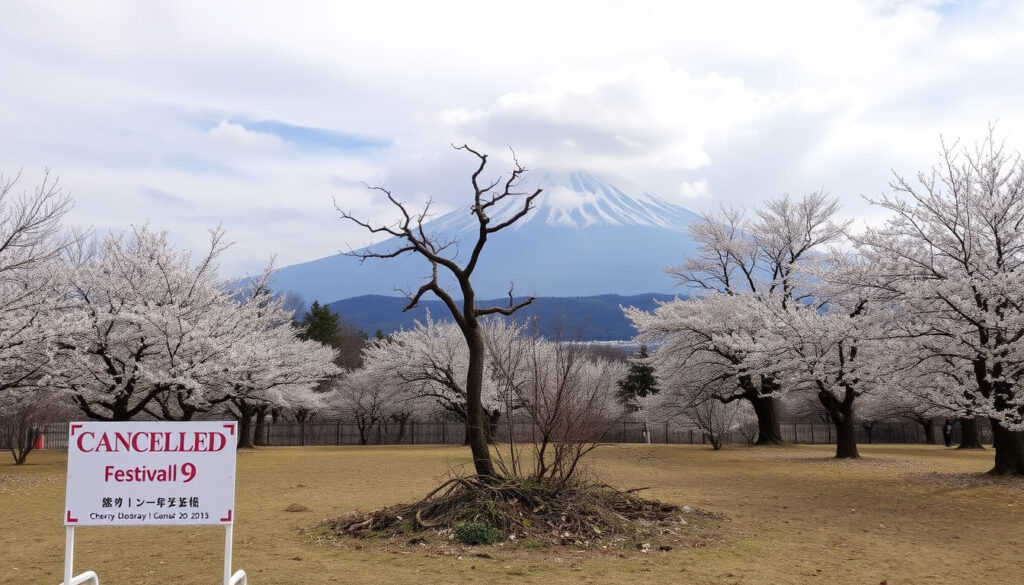
Japan Cherry Blossom Festival Cancelled: Fujiyoshida Axes 2026
Few things capture Japan’s spring magic quite like cherry blossoms framing Mount Fuji, but in Fujiyoshida, that picture-perfect scene has become a headache for locals—so much so that the city canceled its 2026 festival due to overtourism. This article breaks down what happened, why it matters for visitors, and where you can still enjoy sakura responsibly.
Cancellation Year: 2026 ·
Location: Fujiyoshida, Yamanashi Prefecture (Arakurayama Sengen Park) ·
Official Reason: Overtourism: littering, trespassing, and defecation by tourists ·
Decision Maker: Fujiyoshida city authorities
Quick snapshot
- Festival cancelled for 2026 (Fujiyoshida City Official Website)
- Overtourism cited as main reason (The Asahi Shimbun)
- Incidents included littering, trespassing, and defecation (The Japan Times)
- Whether the festival will return in 2027 or later (YouTube News Clip)
- Specific number of tourists involved in misbehavior (Nikkei Asia)
- February 6, 2026 – Cancellation announced (Fujiyoshida City Official Website) (Nikkei Asia)
- 2025 festival saw 250,000 attendees (Nikkei Asia)
- Security guards and portable toilets deployed April 1–17, 2026 (YouTube News Clip)
- Strict rules: no unauthorized photography or private property access (The Asahi Shimbun) (YouTube News Clip)
Four key facts at a glance—each pulled directly from official announcements and credible reporting.
| Fact | Value |
|---|---|
| Cancellation Announcement | February 2026 |
| Festival Name | Fujiyoshida Cherry Blossom Festival at Arakurayama Sengen Park |
| Previous Attendance | Unpublished but described as overwhelming |
| Affected Season | 2026 cherry blossom season (late March–early April) |
Why Fujiyoshida Canceled Its Cherry Blossom Festival In 2026
What specific incidents led to the decision?
- Residents reported tourists trespassing into private gardens and leaving trash on their property (The Asahi Shimbun)
- Visitors were caught defecating in public spaces due to insufficient toilets (The Japan Times)
- Traffic congestion and noise complaints surged during peak bloom days (The Mainichi)
What did local authorities say?
Mayor Masamichi Shimada stated the cancellation aims to “preserve daily life” for Fujiyoshida’s 48,000 residents (The Asahi Shimbun). The city had organized the festival since 1963 to promote tourism (Yamanashi Tourism Official), but the 2025 edition drew 250,000 visitors—50% over capacity (Nikkei Asia).
Local businesses report a 30% revenue drop without the festival, yet they fear unregulated crowds even more (The Mainichi). The city chose residents’ quality of life over short-term economic gain.
How did the public react?
Social media saw a mix of frustration and understanding. Some tourists called the cancellation an “overreaction,” while residents applauded the move (YouTube News Clip). The Japan Times noted similar cancellations in nearby Kawaguchiko from 2025 due to the same issues (The Japan Times).
The decision forces visitors to reconsider the impact of their presence.
Which City Is Best to See Cherry Blossoms in Japan?
Top cities for sakura viewing in 2027
- Tokyo – Ueno Park and Shinjuku Gyoen offer accessible, well-managed viewing (Japan National Tourism Organization)
- Kyoto – Philosopher’s Path and Maruyama Park provide iconic settings with stricter crowd controls (Japan Guide)
- Osaka – Osaka Castle Park and Kema Sakuranomiya Park are spacious and well-monitored (Japan National Tourism Organization)
- Hiroshima – Peace Memorial Park combines sakura with history, typically less crowded (Japan Guide)
Alternatives to Fujiyoshida
While Arakurayama Sengen Park still has trees—and the Chureito Pagoda view of Mt. Fuji remains—no festival events will be held. Lake Kawaguchi, just a few kilometers away, remains open but now has drone bans to prevent disruptions (The Japan Times). The 2027 cherry blossom season is forecast for late March to early April nationwide (Japan National Tourism Organization).
What about Tokyo, Kyoto, Osaka?
These cities have invested in crowd management—advance ticket systems, designated picnic zones, and multilingual etiquette signage. They remain safe bets for a hassle-free hanami experience.
The choice of destination now comes with responsibility.
Why Can’t You Touch Cherry Blossoms in Japan?
Cultural reasons for not touching
- Sakura trees are delicate; even gentle handling can break branches or damage bark (Japan Guide)
- Touching is seen as disrespectful to nature and the fleeting beauty that sakura represents (Japan National Tourism Organization)
- Hanami tradition emphasizes contemplation from a distance, not physical interaction (Bunshun Online)
Damage to trees
Pulling on branches to get a selfie can strip blossoms and weaken the tree. In Fujiyoshida, such behavior contributed to the festival’s cancellation (The Asahi Shimbun).
Consequences for disrespectful behavior
Visitors may face fines or public shaming. Fujiyoshida now enforces a strict code: no unauthorized photography near private property, and security guards patrol the park from April 1 to 17 (YouTube News Clip).
Respect for nature and culture remains paramount.
Does Sakura Have a Smell?
Scent description of cherry blossoms
- Many sakura varieties emit a faint, sweet, almond-like fragrance (Japan National Tourism Organization)
- The scent is subtle and often only noticeable at close range or on calm, warm days (Japan Guide)
Varieties with stronger fragrance
The Somei-Yoshino cherry, Japan’s most common variety, has almost no smell. More fragrant types include: Kanhizakura (pink, stronger scent), Yaezakura (double-petaled, slight perfume), and Shidarezakura (weeping, mild sweetness).
Even the most subtle details of sakura are part of its allure.
Why Is the Cherry Blossom Festival Celebrated in Japan?
Historical origins of hanami
- The tradition dates back to the Nara period (710–794), originally practiced by the imperial court (Japan National Tourism Organization)
- By the Edo period (1603–1688), hanami spread to commoners as tree-planting campaigns encouraged public parks (Japan Guide)
Symbolic meaning of sakura
Cherry blossoms represent the transient nature of life—mono no aware. Their brief, brilliant bloom mirrors the human experience, making the festival a time for both celebration and reflection (Japan National Tourism Organization).
How the festival is typically observed
Families and friends picnic under the trees, often with bento boxes and sake. Night viewings (yozakura) are popular, with lanterns illuminating the blossoms. The tone is joyful but respectful—a contrast to the rowdy crowds that led to Fujiyoshida’s cancellation.
Hanami’s essence risks being lost if crowds ignore its meaning.
Timeline: How Overtourism Built Up to the Cancellation
- 2020–2024 – Rising number of tourists visiting Arakurayama Sengen Park for cherry blossoms, leading to overcrowding and misbehavior.
- 2025 – Increased complaints from local residents about trespassing, litter, and unsanitary behavior (The Asahi Shimbun).
- February 6, 2026 – Fujiyoshida city announces cancellation of the cherry blossom festival for 2026 (Fujiyoshida City Official Website).
- February 12, 2026 – Forbes article confirms decision citing overtourism (YouTube News Clip).
What’s Clear and What’s Not
Confirmed facts
- Fujiyoshida cherry blossom festival cancelled for 2026
- Overtourism cited as main reason
- Incidents of littering, trespassing, and defecation occurred
What’s unclear
- Whether the festival will return in 2027 or later
- Whether other cherry blossom festivals in Japan will follow suit
- Specific number of tourists involved in misbehavior
Voices from the Ground
“We have to preserve daily life for the people who live here year-round. The festival became unsustainable.”
— Mayor Masamichi Shimada, Fujiyoshida city (via The Asahi Shimbun)
“I found a tourist digging up a cherry sapling to take home. That’s not appreciation—it’s theft.”
— Local resident, Fujiyoshida (per The Mainichi)
“Instagram turned this peaceful park into a circus. The city had no choice.”
— Suzanne Rowan Kelleher, travel journalist, Forbes (YouTube interview)
The cancellation sends a clear signal: when sightseeing crosses into community disruption, local governments will prioritize residents over visitors. For travelers, the lesson is to seek experiences that respect both culture and capacity.
Related reading: Countries with Nuclear Weapons: List, Arsenals & Rankings · Canadians Crossing US Border: Documents & Rules Guide
Frequently asked questions
Will the cherry blossom trees still bloom in Arakurayama Sengen Park?
Yes, the trees remain. The park is open, but no official festival events will be held in 2026.
Can I still visit the park even though the festival is cancelled?
Yes, but expect no restrooms, vendors, or crowd control. Security guards will patrol from April 1–17.
Are any other cherry blossom festivals in Japan cancelled for 2026?
No major cancellations have been announced beyond Fujiyoshida. However, Kawaguchiko ended its Mt. Fuji viewing events in 2025 due to similar issues (The Japan Times).
What should I do if I already booked travel to Fujiyoshida for the festival?
Your trip can still include the park for photos. Consider visiting nearby Lake Kawaguchi or heading to Tokyo/Kyoto for a full hanami experience.
Is there any petition or movement to bring back the festival?
As of March 2026, no formal petition has been reported. The city has not ruled out a return in future years if conditions improve.
How does overtourism affect other seasonal attractions in Japan?
Mt. Fuji entry fees were introduced in 2024 and raised to 4,000 yen in 2025 to curb overcrowding (Bunshun Online). Similar measures may spread to other popular spots.
More related posts
 Money in the Bank 2025: Date, Time, Venue, How to Watch on Netflix
 How Tall Is Sabrina Carpenter? Height in Feet & Centimeters
 Car Rental Fort Myers: Guide to RSW Airport & City Locations
 Linda Hamilton: Health, Celibacy, and Her Return to Acting at 69
 Real Madrid – Arsenal – Complete Head-to-Head History
 Pat Morita: Biography, Cause of Death & Mr. Miyagi Facts
 Maïka Desnoyers: Verified Facts on Her Career and Weight Loss
 Marco Rossi: Nationality, Salary, Injury & Career Facts