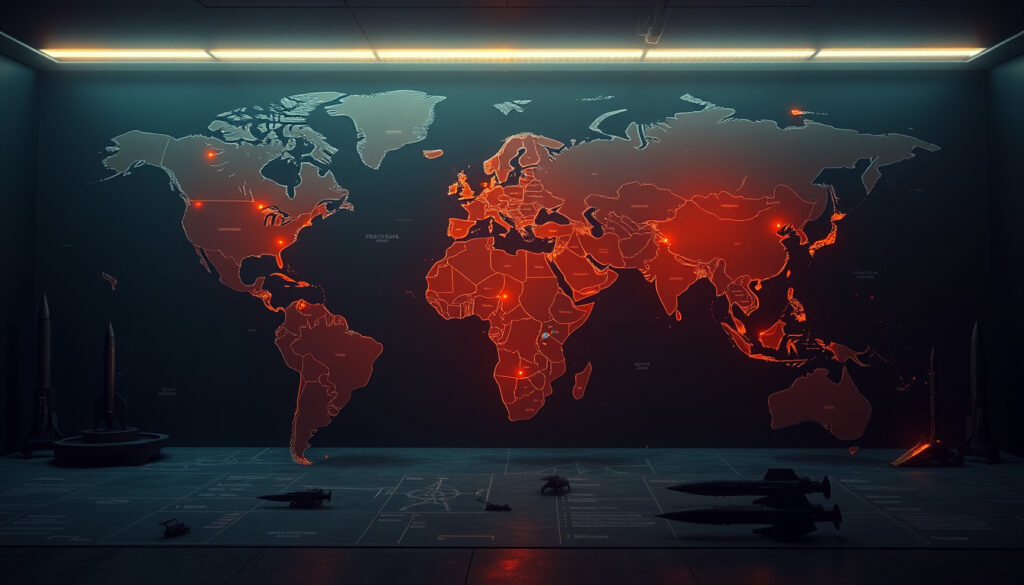
Countries with Nuclear Weapons: List, Arsenals & Rankings
Nine countries currently hold nuclear weapons—and the gap between the largest arsenals and the smallest is staggering. Russia and the United States alone account for nearly 90% of the world’s roughly 12,000 warheads, while four other nations operate outside the international treaty framework that defines the rest. This piece breaks down who has what, how the system that regulates them works, and where the real risks lie.
Nuclear-armed countries: 9 · NPT-recognized states: 5 · Largest arsenal: Russia (5,459 warheads) · US arsenal: 5,177 warheads · Global total: ~12,121 warheads
Quick snapshot
- Nine countries possess nuclear weapons (ICAN)
- Russia holds the largest stockpile at 5,459 warheads (World Population Review)
- Russia and US together account for roughly 86-90% of all warheads globally (Federation of American Scientists)
- Exact warhead counts for Israel and North Korea remain estimates
- Israel officially maintains nuclear ambiguity—no confirmed number
- North Korea’s program progress difficult to verify independently
- Russia suspended New START participation in February 2023 (Arms Control Association)
- China’s arsenal grew from 410 to 500 warheads between January 2023 and December 2025 (SIPRI)
- France announced stockpile increase plans in July 2025 (Arms Control Association)
- China reportedly on track to reach 1,000 warheads by 2030 (Arms Control Association)
- Global stockpiles likely to increase for fifth consecutive year (Arms Control Association)
- North Korea continues nuclear-capable missile development (SIPRI)
Nine countries span two distinct legal categories when it comes to nuclear possession. The table below captures the current arsenal landscape across all possessors.
| Country | Warheads (est.) | Status | Global share |
|---|---|---|---|
| Russia | 5,459 | NPT nuclear-weapon state | 45.1% |
| United States | 5,177 | NPT nuclear-weapon state | 38.0% |
| China | 600 | NPT nuclear-weapon state | 6.36% |
| France | 290 | NPT nuclear-weapon state | 2.98% |
| United Kingdom | 225 | NPT nuclear-weapon state | 2.31% |
| India | 172 | Non-NPT | 1.95% |
| Pakistan | 170 | Non-NPT | 1.74% |
| Israel | 90 | Non-NPT, undeclared | 0.92% |
| North Korea | 50 | Non-NPT (withdrew 2003) | Unspecified |
Warhead estimates draw from SIPRI Yearbook 2024 (authoritative research institute), the Federation of American Scientists’ global inventory tracker, the Arms Control Association’s factsheets, and World Population Review’s 2025 rankings.
How many countries have nuclear weapons?
Nine countries currently possess nuclear weapons: Russia, the United States, China, France, the United Kingdom, India, Pakistan, Israel, and North Korea. This total has remained stable since North Korea declared itself a nuclear state in 2006, though estimates for two of those nations—Israel and North Korea—vary considerably depending on the source.
The global inventory stood at roughly 12,121 warheads as of early 2024, according to SIPRI estimates. That figure represents a long decline from the Cold War peak of approximately 70,000 warheads, though the trend has begun reversing in recent years as modernization programs expand arsenals in several nations.
Recognized NPT states
The Nuclear Non-Proliferation Treaty (NPT), which entered into force in 1970, legally designates five countries as nuclear-weapon states: the United States, Russia, the United Kingdom, France, and China. These five are the only nations officially recognized under international law to possess nuclear weapons. They account for roughly 90% of all warheads globally.
Other possessors
Four countries possess nuclear weapons outside the NPT framework. India and Pakistan both tested devices in the late 1990s and have never signed the treaty. Israel maintains a policy of deliberate ambiguity—neither confirming nor denying its nuclear capability, though estimates consistently place its arsenal around 90 warheads. North Korea announced its withdrawal from the NPT in 2003 and has since conducted six nuclear tests.
Which country is strongest in nuclear weapons?
Russia maintains the world’s largest nuclear arsenal by total inventory, with approximately 5,459 warheads as of mid-2025. The United States holds second position with around 5,177 warheads. Together, these two nations control roughly 86-90% of all nuclear weapons worldwide, a concentration that has defined strategic stability since the Cold War.
Arsenal size rankings
Beyond the top two, China has rapidly expanded its inventory from 410 warheads in January 2023 to approximately 600 by late 2025— SIPRI documented a 90-warhead increase in a single year. France maintains 290 warheads, while the United Kingdom holds 225. In South Asia, India and Pakistan possess roughly comparable arsenals at 172 and 170 warheads respectively, maintaining a tense regional balance.
Warhead estimates by country
Several factors complicate direct comparisons. The United States military stockpile totaled approximately 3,708 warheads as of January 2024 according to SIPRI Yearbook data, but this refers to active stockpiles rather than total inventory. Russia and the US also deploy nonstrategic weapons—systems designed for battlefield use rather than strategic deterrence—with the US reportedly deploying around 100 such warheads in Europe.
“Russia and the USA together possess almost 90 per cent of all nuclear weapons.”
— SIPRI, Stockholm International Peace Research Institute (independent research institute)
Raw numbers can mislead. Russia’s larger total inventory doesn’t automatically translate to greater strategic capability—the US deploys more warheads on intercontinental ballistic missiles. China’s real significance lies in its trajectory: a near-doubling in one year suggests ambitions that go beyond minimum deterrence.
What 5 countries are allowed to have nuclear weapons?
Under the Nuclear Non-Proliferation Treaty, five nations are legally permitted to possess nuclear weapons: China, France, Russia, the United Kingdom, and the United States. This status stems from their designation as nuclear-weapon states before the NPT entered into force in 1970. All five ratified the treaty and pledged to pursue disarmament—a commitment that remains unfulfilled more than five decades later.
NPT nuclear-weapon states
The five NPT-recognized states each maintain distinct nuclear doctrines. The United States and Russia have reduced their arsenals through bilateral agreements, though Russia suspended New START participation in February 2023, leaving inspection regimes in limbo. China maintains the only unqualified “no first use” policy among the five, pledging never to use nuclear weapons first in a conflict. France and the United Kingdom operate much smaller, independent deterrent forces focused on national security.
Non-NPT possessors
Four nuclear-armed states never joined the NPT or withdrew from it. India and Pakistan tested nuclear devices in 1998 and have since built substantial arsenals amid ongoing tensions over Kashmir. Israel has never formally acknowledged its nuclear capability but is widely assessed to maintain an arsenal of approximately 90 warheads under its policy of ambiguity. North Korea announced its withdrawal from the NPT in 2003 and has since conducted six underground nuclear tests while developing nuclear-capable cruise missiles as of 2023.
Nuclear Weapons: Who Has What at a Glance
Understanding the global nuclear landscape requires separating total stockpiles from deployed forces, strategic from nonstrategic weapons, and retired warheads awaiting dismantlement from those in active service. The numbers below represent best available estimates from multiple authoritative tracking efforts.
Current arsenal snapshots
SIPRI’s 2024 Yearbook estimated approximately 12,121 total nuclear warheads globally. The Federation of American Scientists projects a slightly higher figure of 12,187 warheads entering 2026, reflecting recent expansions. Active military stockpiles—warheads assigned to operational forces—total roughly 9,585 to 9,600 globally.
The geographic distribution extends beyond national borders. The United States reportedly stores weapons at bases in Belgium, Germany, Italy, the Netherlands, and Turkey as part of NATO’s nuclear-sharing arrangements. The United Kingdom and France maintain independent national deterrent forces without external deployments.
Key estimates from sources
Estimates vary by source and methodology. The SIPRI Yearbook 2024 provides the most widely cited figures, drawing on open-source intelligence and government disclosures where available. The World Population Review aggregates multiple tracking efforts into its 2025 rankings. ICAN maintains an overview of all nine possessor states and US hosting arrangements. For Israel and North Korea, where official data does not exist, estimates derive from intelligence assessments and technical analysis.
“Israel does not admit nor deny having nuclear weapons, and states that it will not be the first to introduce nuclear weapons in the Middle East.”
— Israeli government policy statement, cited by Arms Control Association (specialist nonpartisan organization)
The gap between declared transparency and operational secrecy shapes how analysts assess risks. Russia’s New START suspension means the world now lacks reliable data on Russian deployment patterns—the very information needed to assess escalation potential.
Who gave Israel nuclear weapons?
No confirmed donor nation has been definitively identified in publicly available sources as having provided Israel with nuclear weapons or fissile material. Israel’s nuclear program developed largely through indigenous capability beginning in the late 1950s, though the exact origins remain classified and subject to competing narratives.
Israel’s program history
The Dimona reactor in the Negev desert served as the centerpiece of Israel’s effort, with construction beginning in the late 1950s under a veil of civilian nuclear cooperation. French assistance with the reactor is well-documented, though French officials consistently characterized this as part of civilian nuclear programs. The United States provided nuclear technology under various agreements, though specific military applications remain disputed.
Reported assistance
Analysts and investigative journalists have proposed various accounts of foreign involvement, but none have been confirmed through official documentation. The Arms Control Association notes that Israel is believed to maintain its weapons in a partially disassembled state—meaning warhead cores stored separately from delivery systems—consistent with a policy of ambiguity that avoids explicit confirmation of any arsenal size.
Israel’s nuclear ambiguity serves strategic purposes domestically and diplomatically. Acknowledging the arsenal—or revealing how it was obtained—would undermine leverage with regional adversaries and complicate US arms control negotiations with Middle Eastern allies. This opacity is deliberate policy, not intelligence failure.
Upsides
- Global arsenal has declined dramatically from Cold War peak of ~70,000 warheads
- NPT framework provides legal basis for disarmament obligations
- Bilateral US-Russia arms control reduced deployed strategic warheads
Downsides
- Global stockpiles now increasing for fifth consecutive year
- Russia suspended New START, eliminating inspection regime
- Four states operate completely outside NPT framework
List of states with nuclear weapons
The nine nuclear-armed states rank consistently across tracking efforts, though exact figures vary by source. The table below presents current estimates ranked by total estimated inventory.
| Rank | Country | Est. warheads | Source |
|---|---|---|---|
| 1 | Russia | 5,459 | World Population Review (2025) |
| 2 | United States | 5,177 | World Population Review (2025) |
| 3 | China | 600 | Arms Control Association (2025) |
| 4 | France | 290 | Arms Control Association (2025) |
| 5 | United Kingdom | 225 | World Population Review (2025) |
| 6 | India | 172 | Arms Control Association (2024) |
| 7 | Pakistan | 170 | Arms Control Association (2024) |
| 8 | Israel | 90 | Arms Control Association (2024) |
| 9 | North Korea | 50 | SIPRI (2024) |
Full ranked list
Russia and the United States dominate numerically, together accounting for roughly 86-90% of all nuclear weapons. China’s 600 warheads represent the third-largest arsenal, though this figure masks rapid recent growth—the country added approximately 90 warheads in 2023 alone according to SIPRI analysis, and reports suggest China is on track to reach 1,000 warheads by 2030.
Share percentages
When calculating global share, Russia holds approximately 45.1% of the worldwide inventory, the United States approximately 38.0%, and China approximately 6.36%. France, the United Kingdom, India, and Pakistan each hold between 1.7% and 3%. Israel’s undeclared arsenal represents under 1% by most estimates, while North Korea accounts for an similarly small fraction of global holdings.
“SIPRI’s estimate of the size of China’s nuclear arsenal increased from 410 warheads in January 2023 to 500 in December 2025.”
— SIPRI (independent research institute)
Summary
The global nuclear landscape in 2025 presents a paradox: total arsenals remain far below Cold War levels, yet the trend has reversed for the fifth consecutive year. Russia and the US still control nearly 90% of all warheads, but their inspection regime lies suspended, reducing transparency precisely when tensions run high. China expands fastest, while India, Pakistan, North Korea, and Israel operate entirely outside the treaty’s framework.
The mechanisms designed to manage nuclear competition have weakened while the competitive dynamics themselves intensify. For citizens in nuclear-armed states, the question is no longer whether the world lives under a nuclear overhang, but how much heavier that shadow will grow.
Related reading: Is Nuclear Energy Renewable? Facts, France & Debate
While Russia and the US dominate with over 90% of global warheads, the ongoing Iran-US nuclear standoff highlights proliferation risks from aspiring nuclear states outside the NPT.
Frequently asked questions
How many countries have nuclear weapons?
Nine countries currently possess nuclear weapons: Russia, the United States, China, France, the United Kingdom, India, Pakistan, Israel, and North Korea. The global total stands at roughly 12,121 warheads as of early 2024.
What are the 7 nuclear countries?
The phrase “7 nuclear countries” typically refers to the original nuclear-armed states before North Korea joined the club in 2006. The seven include the five NPT nuclear-weapon states (US, Russia, China, France, UK) plus India and Pakistan. Counting Israel brings the modern total to nine.
Who decides which countries can have nuclear weapons?
The Nuclear Non-Proliferation Treaty (NPT), which entered into force in 1970, designates five countries as legally permitted nuclear-weapon states. However, the treaty has not prevented four additional states from acquiring weapons outside its framework, and enforcement depends on political will rather than automatic mechanisms.
Can the US stop a nuke from hitting us?
US missile defense systems are designed to intercept limited numbers of incoming warheads, not comprehensive nationwide protection. The Ground-Based Midcourse Defense system protects against limited ICBM attacks from rogue states, but no system can guarantee interception of all incoming warheads in a large-scale attack.
Can missile defence against nuclear attack work?
Current missile defense technology faces fundamental challenges: distinguishing warheads from decoys, achieving intercept at high speeds, and scaling to handle multiple warheads. The US, Russia, and China all continue investing in missile defense, but no nation has demonstrated reliable capability against saturation attacks.
Should you shower after a nuke?
In the event of nuclear detonation, sheltering indoors and staying tuned to emergency broadcasts takes priority over immediate decontamination measures. Showering may help remove radioactive particles from skin, but official guidance emphasizes remaining indoors, sealing windows, and awaiting official instructions.
Why is Israel so powerful?
Israel’s regional power stems from multiple factors: a technologically advanced economy, mandatory military service producing a large veteran population, US military backing, and strategic alliances. Its undeclared nuclear arsenal—estimated around 90 warheads—adds a deterrent dimension, though the country maintains official ambiguity about its capabilities.
How many nuclear bombs in the world?
The world holds approximately 12,121 nuclear warheads according to SIPRI 2024 estimates, with roughly 9,585-9,600 in active military stockpiles. This represents a significant decline from the Cold War peak of approximately 70,000, though figures have increased in recent years as modernization programs expand arsenals.
More related posts
 Mini Split Heat Pump: Pros, Cons, Costs & Installation
 La Grande Roue de Montreal – Height Tickets Location Guide
 CRA Payroll Calculator 2025: Free Online Deductions Tool
 Houses for Sale in Burlington ON – 1,269 Listings $1.1M
 Calgary’s 14-Day Weather Forecast: From -4°C to 22°C Highs
 How to Fix a Slow Mac: Performance Tips from Apple
 Maïka Desnoyers: Verified Facts on Her Career and Weight Loss
 Amazon Canada Online Shopping: Switch Regions, Ship & Save