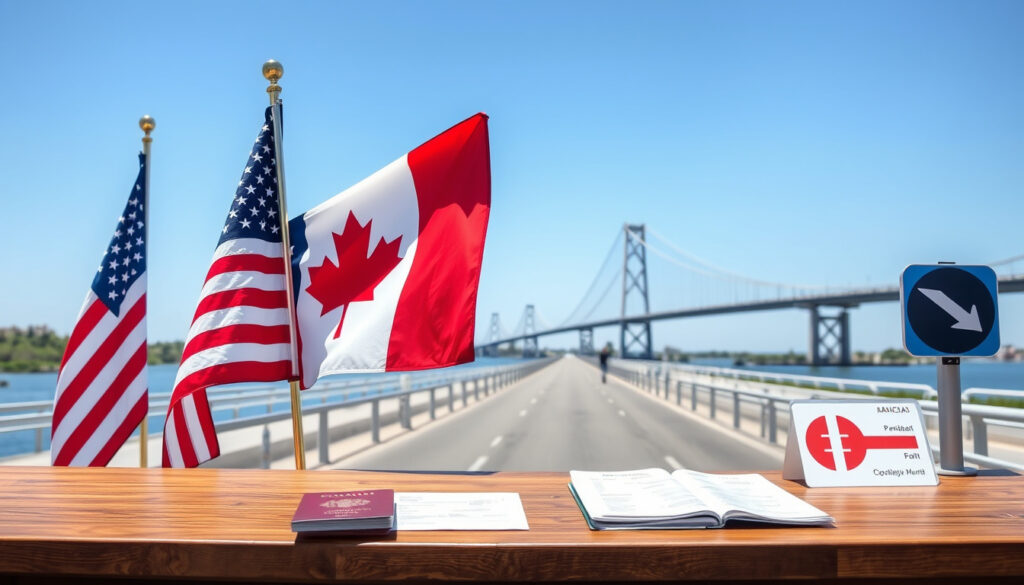
Canadians Crossing US Border: Documents & Rules Guide
Canadians heading south this winter face a transformed border landscape. What once was a straightforward drive across with a passport now involves new registration steps, biometric checks, and a fee that didn’t exist a year ago. The good news: Canadians can still cross — you just need to know which documents to carry and when you need to register.
Air entry document: Valid passport or NEXUS card · Extended stay trigger: 30 days or more · Registration options: Form I-94 ($30) or Form G-325R (free) · Biometric rule effective: December 26, 2025
Quick snapshot
- Canadians can stay up to 182 days per year visa-free (VRCD)
- Passport or NEXUS required for entry; passport must be valid for entire stay (Berardi Immigration Law)
- Registration required for stays of 30 days or more, effective April 11, 2025 (Snowbird Advisor)
- Exact application scope of any proposed entry fee beyond the $30 I-94 processing fee
- Level of enforcement consistency across different land border crossings
- Whether the “Lonely Canadian” rule will be formally codified in 2025-2026 regulations
- April 11, 2025: Registration requirement took effect (Snowbird Advisor)
- Mid-October 2025: I-94 processing began at some land borders (Snowbird Advisor)
- December 26, 2025: Biometric entry-exit rule takes effect (Canada to USA)
- U.S. authorities continue emphasizing compliance with registration laws for extended stays
- Biometric collection procedures may vary by port and officer discretion
- Snowbirds should verify I-94 issuance at each crossing or file Form G-325R within 30 days
| Requirement | Details |
|---|---|
| Air travel document | Passport or NEXUS card |
| Land border document | Valid Canadian passport or NEXUS; passport must cover entire stay |
| Extended stay trigger | 30 consecutive days or more in the United States |
| Form I-94 fee | $30 USD (includes fingerprinting and photographing) |
| Form G-325R fee | No fee (free to file with USCIS) |
| Visa-free stay limit | 182 days per year without a visa |
| Biometric rule effective date | December 26, 2025 |
| Registration deadline | Within 30 days of entry (if no I-94 issued) |
Can Canadians still cross the border into the USA?
Yes — Canadians can still cross into the United States, and citizens generally do not need a visa for tourism or short visits. The standard visa-free allowance lets Canadians stay up to 182 days per year without any special documentation, according to VRCD.
Visa exemptions for citizens
Canadian citizens benefit from a visa waiver program that covers short-term visits for tourism, family visits, and business meetings. A valid Canadian passport or NEXUS card serves as the primary entry document at land, air, and sea ports. Your passport must remain valid for the entire duration of your stay — U.S. Customs and Border Protection will not admit travellers beyond the expiration date on their passport, as noted by Berardi Immigration Law.
Permanent resident requirements
If you hold permanent resident status in Canada but are not a Canadian citizen, the rules differ. Permanent residents of Canada generally need to obtain a non-immigrant visa before entering the United States. This applies regardless of how long you plan to stay or which documents you carry from Canada.
Canadian citizens do not need a visa for B-2 visitor status — that status is granted automatically at the border. Permanent residents, however, must apply for the appropriate visa before travelling.
What does a Canadian need to cross the US border by car?
The documents themselves haven’t changed dramatically — you’ll need proof of Canadian citizenship and identity. Where things have shifted is the compliance side if you plan to stay beyond 30 days. Snowbird Advisor outlines the key requirements.
Required documents
- Valid Canadian passport (must cover entire stay)
- Or NEXUS card for expedited crossing
- Proof of ties to Canada if questioned about residence
- For extended stays: awareness of Form I-94 or Form G-325R requirements
NEXUS and trusted traveler programs
The NEXUS program remains a practical option for frequent crossers. It lets approved members use dedicated lanes at land borders and skip regular processing queues. At air ports, NEXUS members can use Global Entry kiosks. The enrollment process takes a few months, but for snowbirds making multiple trips, it pays for itself in time saved.
NEXUS speeds up routine crossings, but it does not exempt you from registration requirements. If you stay 30 days or more, the I-94 or Form G-325R rules still apply regardless of trusted traveler status.
Will Canadians have to pay $250 to enter the US?
This question keeps surfacing in online discussions, but the verified picture from official sources is more specific. There is a documented $30 USD fee attached to Form I-94 processing at land borders, which includes fingerprinting and photographing. What gets called a “$250 fee” in some sources refers to a proposed rulemaking that has not been finalized as of the information available.
Fee implementation date
The $30 I-94 processing fee has been in effect since mid-October 2025 when some land border crossings began enforcing the registration requirements, according to Snowbird Advisor. If you request an I-94 at the border, the $30 applies immediately. If you skip the I-94 and file Form G-325R online with USCIS instead, there is no fee.
Who it applies to
The $30 I-94 fee applies to Canadians entering by land who are planning stays of 30 days or more and who request the I-94 form at the crossing. It does not apply to short visits, air travelers who already have passport-based entries recorded, or those who file the free Form G-325R instead. Berardi Immigration Law notes that if snowbirds make multiple trips during a season, each I-94 costs $30 — and those fees add up quickly.
U.S. authorities continue to signal heightened compliance focus on extended Canadian visitors. The penalty for failing to register — if no I-94 was issued and no Form G-325R was filed — can include fines or criminal consequences.
Can a Canadian citizen be denied entry to the USA?
Being a Canadian citizen does not guarantee entry to the United States. U.S. Customs and Border Protection officers retain discretion to deny admission to foreign nationals — including Canadians — if they believe the visitor intends to work, immigrate, or overstay their welcome. Canadian Snowbird Association provides guidance on what triggers closer scrutiny.
Common denial reasons
- Evidence of intending to work without authorization
- Spending more days in the U.S. than in Canada without clear financial support proof
- Prior immigration violations or overstays
- Inconsistent answers about length of stay or purpose of visit
- Expired or damaged travel documents
What to do if denied
If a CBP officer denies entry, the traveller has limited options at that moment. The officer will issue a removal order, and the traveller must leave the United States via the port of entry or be transported to Canada by CBP. For Canadians who believe a denial was improper, legal counsel specializing in U.S. immigration law can file a motion to reopen, though this process can be lengthy and costly. The key is to be prepared with documentation — proof of return travel, evidence of Canadian residence, and a clear, consistent story about your plans.
If a snowbird spends more days in the U.S. than in Canada, CBP officers may ask how they support themselves and whether they are maintaining a true residence north of the border. Canadians who blur the line between visitor and resident are the ones who face the most scrutiny.
What are the new registration requirements for Canadian snowbirds?
This is where the biggest changes have landed. As of April 11, 2025, Canadians staying in the U.S. for 30 days or more face new federal registration rules. The requirement comes from U.S. authorities placing increased emphasis on compliance with registration laws for Canadian tourists spending extended periods, according to Canadian Snowbird Association.
Reporting rules post-April 11
The core rule: if you enter the U.S. by land and plan to stay 30 consecutive days or more, you may be required to register with the U.S. government. There are two pathways. The first is to request a Form I-94 at the border crossing — this costs $30 and involves fingerprinting and photographing during secondary inspection, which adds 30-60 minutes or more to crossing time during busy periods. The second pathway, available if no I-94 was issued at your crossing, is to file Form G-325R online with U.S. Citizenship and Immigration Services within 30 days of entry — and this costs nothing.
Snowbird compliance
Canadians who are issued a Form I-94 for their most recent entry are already registered and do not need to file Form G-325R, as noted by Snowbird Advisor. Those who are NOT issued an I-94 must register online with USCIS by completing and submitting Form G-325R — and this registration must happen after entering the U.S., not before.
Once a snowbird registers with Form G-325R, they have fulfilled their federal obligation for that stay period and do not need to repeat the process unless they leave and re-enter for another 30+ day period without receiving an I-94 at the border.
Timeline
- : Registration requirement for Canadian snowbirds taking extended stays took effect
- : Some land border crossings began requiring Form I-94 processing for stays of 30 days or more
- : CBP published final biometric entry-exit rule authorizing collection of facial photographs from all non-U.S. citizens
- : New biometric entry-exit rule takes effect at air, land, and sea ports
What we know — and what we don’t
Four verified facts define the current landscape: Canadians need a passport or NEXUS card for entry; stays of 30 days or more trigger registration requirements; Form I-94 costs $30 and Form G-325R is free; and a biometric rule takes effect December 26, 2025 covering all ports of entry.
What remains less clear is the consistency of enforcement across different land border crossings. The Canadian Snowbird Association has reported inconsistent experiences at various crossings regarding when officers invoke I-94 processing versus letting travellers pass without registration, according to Canadian Snowbird Association. The application of biometric collection procedures appears to vary depending on the individual border officer and location.
For now, the practical advice from official sources is to cross the border as you normally would, verify upon arrival whether an I-94 form has been issued, and if it has not been issued, file Form G-325R with USCIS within 30 days of entry. Stay informed as enforcement patterns develop through the winter season.
What the experts say
“The Canadian Snowbird Association recommends that members continue to cross the border as they normally would and verify upon arrival whether an I-94 form has been issued.”
— Canadian Snowbird Association
“Form G-325R is the official registration form designed for Canadians entering by land or sea without an I-94 who remain 30 consecutive days or longer. Once a snowbird registers with Form G-325R, they have fulfilled their federal obligation for that stay period.”
— Berardi Immigration Law
“U.S. authorities are now placing increased emphasis on compliance with registration laws for Canadian tourists spending 30 or more days in the United States.”
— Canadian Snowbird Association
For Canadian snowbirds planning winter escapes south, the rules have become more complex but not prohibitively so. Canadians who stay under 30 days face essentially the same process as before. Those planning longer visits need to understand the two-pathway registration system and act within the 30-day window if no I-94 is issued at the border.
Related reading: Canadian snowbirds US border registration guide
Canadians heading south by car or air must check the 2025 requirements guide for updates like the new $30 I-94 fee and snowbird rules.
Frequently asked questions
Do Canadians need a visa for short US visits?
No. Canadian citizens do not need a visa for tourism or short-term visits to the United States. B-2 visitor status is granted automatically at the border. Permanent residents of Canada, however, do need a non-immigrant visa regardless of visit length.
What is NEXUS for border crossing?
NEXUS is a trusted traveler program jointly administered by Canada and the United States. Approved members use dedicated lanes at land borders and Global Entry kiosks at airports, speeding up the crossing process. It does not exempt members from registration requirements for extended stays.
What travel advisories apply to Canadians visiting the USA?
Canadians travelling to the USA should carry a valid passport, be prepared to demonstrate ties to Canada if questioned, and understand the registration requirements if staying more than 30 days. The Canadian government’s travel advisories recommend checking passport validity and being aware of local laws in the destination state.
What documents are needed for land border crossings?
A valid Canadian passport or NEXUS card is required for entering the United States by land. Your passport must be valid for the entire duration of your stay. For extended stays of 30 days or more, be aware of Form I-94 (optional, $30) or Form G-325R (free, must file within 30 days of entry if no I-94 was issued).
What happens if I don’t register after a long stay?
Failure to comply with registration requirements could result in fines or even criminal penalties, according to U.S. authorities. If you were not issued a Form I-94 and did not file Form G-325R within 30 days of entry, you may face consequences upon future border crossings or visa applications.
How do the new biometric rules affect Canadians?
Effective December 26, 2025, U.S. Customs and Border Protection began collecting biometric information — primarily facial photographs, and in some cases fingerprints — from all non-U.S. citizens upon entry to and departure from the United States. The rule applies to all modes of travel: air, land, and sea.
Can I apply for Form I-94 before arriving at the border?
No. Form I-94 processing occurs at the land border crossing itself, not in advance. This means routing through secondary inspection, which can add 30-60 minutes or more to crossing time during busy periods. If you want to avoid this delay and potential fee, you can skip requesting an I-94 and instead file Form G-325R online within 30 days after entering.
More related posts
 Manny Jacinto Movies and TV Shows – Complete Filmography Guide
 Doug Ford Speed Cameras – Ontario Ban Stands Amid Debate
 Huddersfield vs Man City – 2-0 Win in Carabao Cup Third Round
 Inter Milan vs FC Barcelona Lineups: Confirmed & Historical
 Buffalo Bills vs Baltimore Ravens Match Player Stats & Box Scores
 Filipino Store Near Me – Top Chains, Products and Tips
 Willa Fitzgerald Movies and TV Shows: Complete List