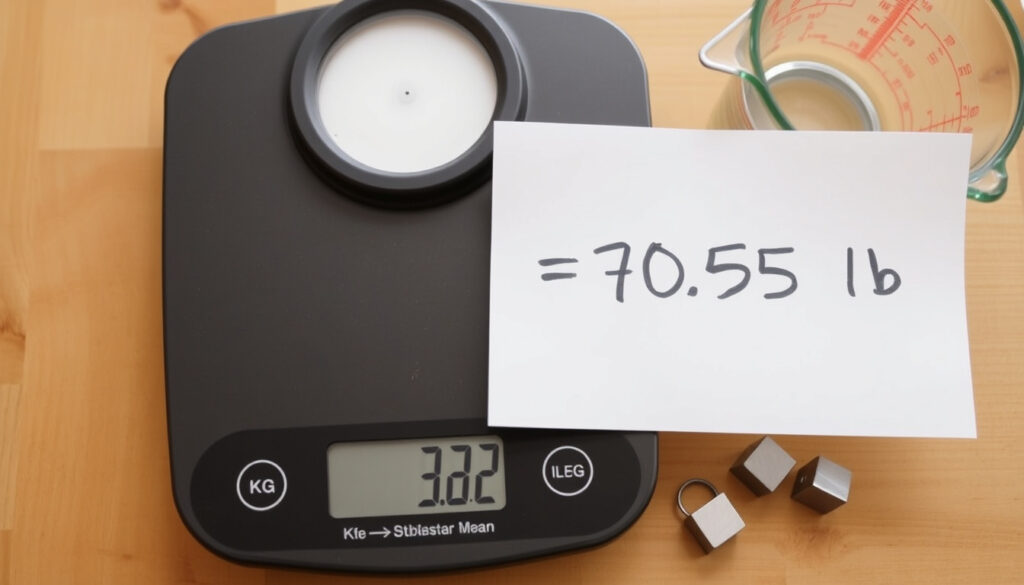
32 kg to lbs – Exact 32 kg to Pounds Conversion (70.55 lb)
When you need to convert 32 kg to lbs, the number might seem straightforward, but the right answer depends on what you’re weighing—luggage, body weight, or a parcel. For a standard conversion, 32 kilograms equals about 70.55 pounds, yet many people also need the value in stones or ounces, especially when traveling or tracking fitness goals.
32 kg to pounds: 70.55 lb ·
32 kg to stones: 5.04 st ·
32 kg to ounces: 1128.7 oz ·
Conversion factor: 1 kg = 2.20462 lb
Quick snapshot
- 70.55 lb (DollarTimes conversion tool)
- 1 kg = 2.20462 lb (Metric-Conversions.org)
- 5.04 st (Metric-Conversions.org (stone calculator))
- 1 st = 6.35029 kg (NIST official conversion factors)
- 1128.77 oz (kg-to-lbs.appspot.com)
- 1 kg = 35.274 oz (computed from Wikipedia: Pound (mass))
- 32,000 g (metric base, NIST SI definition)
- 1 kg = 1000 g (NIST SI definition)
Five key numbers, one simple truth: the same 32 kg can be expressed in four different systems, each with its own use case. Here’s the data at a glance.
| Label | Value |
|---|---|
| Exact conversion factor | 1 kg = 2.20462262185 lb (NIST definition) |
| 32 kg in pounds | 70.5479 lb |
| 32 kg in stones and pounds | 5 st 0.5 lb |
| 1 stone | 14 lb = 6.35029 kg (Wikipedia: Stone unit) |
| 32 kg in ounces | 1128.77 oz |
The pattern: once you remember that 1 kg ≈ 2.2 lb, the rest follows—multiply by 2.2, divide by 6.35 for stones, multiply by 35.27 for ounces.
What is 32 kg in weight?
How to convert 32 kg to lbs
Converting 32 kg to lbs is a two-step process. Multiply the number of kilograms by the conversion factor 2.2046226218. According to kg-to-lbs.appspot.com (conversion calculator), that gives exactly 70.5479238992 pounds. For everyday use, you can round to 70.55 lb.
If you’re estimating without a calculator, remember that 1 kg is roughly 2.2 lb. So 32 × 2.2 = 70.4 lb, which is close enough for luggage or grocery shopping.
32 kg to lbs conversion formula
The formula is straightforward: pounds = kilograms × 2.2046226218. For 32 kg: 32 × 2.2046226218 = 70.5479 lb. This factor is defined by the NIST (US standards body) based on the international yard and pound agreement of 1959, which set 1 lb = 0.45359237 kg exactly.
32 kg in pounds and ounces
Since 1 lb = 16 oz, the decimal portion (0.5479 lb) converts to 8.77 oz. So 32 kg = 70 lb 8.77 oz. WeCapable’s conversion tool confirms 32 kg = 70 lb 8.768 oz.
32 kg in stones and pounds
In the UK and Ireland, body weight is often expressed in stones and pounds. One stone = 14 lb = 6.35029 kg (exact NIST conversion factor). Divide 32 by 6.35029 to get 5.038 stones, or 5 stone 1.6 lb. Metric-Conversions.org (stone calculator) shows the same: 5 st 0.5 lb (rounded).
The takeaway: with these three formulas you can convert 32 kg into any imperial unit. The next step is to understand when and why you’d use each one.
Is 1 kg equal to 2 lbs?
Why 1 kg is not exactly 2 lbs
The short answer is no. One kilogram equals 2.20462 lb, not 2 lb. The approximation “1 kg ≈ 2.2 lb” is widely used for quick mental estimates, but it introduces an error of about 9 % on 32 kg if you use 2.0 instead of 2.20462. Metric-Conversions.org (practical guide) notes that the 2.2 factor is accurate enough for most everyday situations.
The exact conversion factor (1 kg = 2.20462 lb)
As defined by NIST (US standards body), 1 kg = 2.20462262185 lb. This precision matters in science, shipping, and sports where even a few ounces can affect a result. For 32 kg, using 2.20462 instead of 2.2 changes the total by about 0.15 lb—less than a flash drive in weight.
Common misconceptions about kg-lb equivalence
- 1 kg = 2.2 lb is an approximation, not a definition.
- 1 lb = 0.4536 kg is the exact definition (NIST (US standards body)).
- Stone ≠ kg: 1 stone = 14 lb, which is about 6.35 kg.
The catch: using “1 kg = 2 lb” for 32 kg gives 64 lb—an error of 6.55 lb (about the weight of a small dog). That’s why precision matters, especially when packing luggage or dosing medication.
What is 160 lb in weight?
How to convert 160 lbs to kg
The reverse conversion: divide pounds by 2.20462. So 160 lb ÷ 2.20462 = 72.57 kg. Rounding to one decimal gives 72.6 kg (Metric-Conversions.org (pounds-to-kg calculator)).
160 lbs in kilograms
160 lb is a common weight for a healthy adult male (about 5’10”) or a moderate load for a suitcase. But in kilograms, 72.57 kg is roughly 2.27 times heavier than 32 kg. For context, 32 kg is about 44 % of 160 lb.
Examples: body weight, luggage limits
Typical airline luggage limits are 23–32 kg (50–70 lb). A 32 kg suitcase (70.55 lb) is already at the high end of many international allowances (IATA baggage guidelines). In contrast, 160 lb (72.6 kg) exceeds most checked luggage limits—reinforcing why the conversion matters when packing.
Why this matters: knowing both directions lets you switch between systems at the airport, at the gym, or in the doctor’s office.
What is 1 stone equal to in kg?
How many kilograms in a stone?
One stone equals 6.35029318 kg exactly (NIST (US standards body)). This unit is still used in the UK, Ireland, and some Commonwealth countries for body weight.
Converting stones to kg and lb
Multiply stones by 6.35 to get kilograms, or by 14 to get pounds. For example, 10 stone = 140 lb = 63.5 kg. For 32 kg (5.04 stone), you can quickly estimate 5 stone and add the remainder: 5 st 0.5 lb.
Common uses of the stone unit
According to Wikipedia: Stone unit, stones are used almost exclusively for human body weight. You will rarely see stones for freight or kitchen recipes. So when someone says “I weigh 11 stone,” they mean 154 lb or 69.9 kg—a number that might be more familiar in the US as pounds.
Stone is intuitive for people who grew up with it, but it adds an extra conversion layer when comparing with metric systems. For a traveler switching between UK and US scales, remembering 1 st ≈ 14 lb ≈ 6.35 kg is the only shortcut you need.
The pattern: once you know the stone conversion, you can quickly convert any weight between systems without digging for a calculator.
What is a BMI of 32kg?
What is BMI?
Body Mass Index (BMI) is a screening tool that uses weight and height to estimate body fat. The CDC (U.S. public health agency) defines the formula: BMI = weight (kg) ÷ height (m)².
How to calculate BMI
For a person weighing 32 kg (about 70.5 lb), you need their height. For example, a child 1.2 m tall: 32 ÷ (1.2 × 1.2) = 22.2 (normal range). But for an adult of average height (1.7 m): 32 ÷ (1.7 × 1.7) = 11.1 – which the NHLBI (NIH) BMI calculator classifies as severely underweight.
BMI categories for adults
According to American Heart Association (cardiovascular health organization):
- Underweight: < 18.5
- Normal: 18.5–24.9
- Overweight: 25–29.9
- Obese: ≥ 30
Does 32 kg alone indicate underweight or obesity?
By itself, 32 kg tells you nothing about health. A BMI value of 32 (kg/m²) is classified as obese, but a weight of 32 kg could be healthy for a short person or a child. CDC (U.S. public health agency) stresses that BMI is a screening tool, not a diagnostic lab.
The catch: here’s an easy mix-up to avoid—the number “32” can mean either weight in kilograms or a BMI score, but the two are completely different measures. Always check the units.
How to convert 32 kg to lbs step by step
Here’s the practical process for anyone who wants to do the math manually or check their understanding.
- Memorize the base: 1 kg = 2.20462 lb (Metric-Conversions.org (standard conversion factor))
- Multiply: 32 × 2.20462 = 70.54784 lb
- Round (optional): 70.55 lb for two decimals
- For stones: 32 ÷ 6.35029 = 5.04 st; the fractional part (0.04 × 14 lb = 0.56 lb) gives 5 st 0.6 lb
- For ounces: 70.55 × 16 = 1128.8 oz (or start from 32 × 35.274 = 1128.77 oz if you prefer direct)
Keep a converter app handy for repeated use, but understanding the logic builds confidence.
Comparison of weight units for 32 kg
Three systems, one weight, four numbers—here’s how 32 kg looks in the units you’re most likely to encounter.
| Unit | Value for 32 kg | Conversion basis |
|---|---|---|
| Pounds (avoirdupois) | 70.55 lb | 1 kg = 2.20462 lb |
| Stones and pounds (UK) | 5 st 0.5 lb | 1 st = 14 lb = 6.35029 kg |
| Ounces | 1128.77 oz | 1 lb = 16 oz |
| Grams | 32,000 g | 1 kg = 1000 g |
The implication: knowing all four lets you read any label without confusion.
Confirmed facts vs. what’s unclear
Confirmed facts
- 1 kg = 2.20462 lb (NIST definition)
- 32 kg = 70.55 lb (rounded to two decimals)
- 1 stone = 6.35029 kg (NIST conversion factor)
- 1 lb = 0.45359237 kg (Wikipedia: Pound (mass))
What’s unclear
- Whether 160 lb is skinny or overweight depends on height, gender, and body composition – no single answer.
- A BMI of “32 kg” is meaningless without height; BMI value 32 (kg/m²) is obese, but weight 32 kg can be healthy for a child.
- Whether the 2.2 approximation is accurate enough for all purposes — can be fine for luggage but not for scientific or shipping precision.
- Whether 32 kg is heavy for a suitcase — depends on the airline’s specific maximum (often 23–32 kg). Without the exact policy, the term “heavy” is relative.
“The kilogram is the base unit of mass in the International System of Units (SI), and its relationship to the pound is defined by the international yard and pound agreement.”
— National Institute of Standards and Technology
“A BMI of less than 18.5 is considered underweight, 18.5 to 24.9 is normal, 25 to 29.9 is overweight, and 30 or higher is obese.”
Knowing the facts helps you avoid common pitfalls: don’t mix up BMI value with body weight, don’t assume 2 lb per kg, and remember that contextual units (stone vs. pound) vary by region.
How 32 kg fits into your daily life
Whether you’re packing for a flight, checking your child’s growth chart, or comparing weight limits at the gym, 32 kg is a moderately light weight—about the same as a small suitcase, a large bag of cement, or a 70‑lb dumbbell. The real value of knowing the conversion across pounds, stones, and ounces is that you can interpret numbers from any part of the world without second-guessing. For a traveler flying out of the US who sees a UK luggage tag in stones, the formula is the bridge: 5 stone ≈ 70 lb ≈ 32 kg. The implication is clear: a quick mental shortcut (1 st ≈ 14 lb) saves time and prevents overweight‑baggage fees.
Frequently asked questions
What is the difference between a pound and a kilogram?
A kilogram (kg) is the base unit of mass in the metric system, while a pound (lb) is an imperial unit. 1 kg is defined as exactly 2.20462262185 lb (NIST). Pounds are used mainly in the US, UK, and a few other countries.
How many ounces are in 32 kg?
32 kg equals 1128.77 ounces. This is calculated by first converting to pounds (70.55 lb) and then multiplying by 16 oz per pound, or directly using 1 kg = 35.274 oz (kg-to-lbs.appspot.com).
Is 32 kg considered heavy for a suitcase?
Most airlines set a checked bag limit between 23 and 32 kg (50–70 lb). A 32 kg suitcase is at the maximum for many carriers, so it would be considered the upper limit of standard weight – but not unusual for heavy domestic flights (IATA baggage guidelines).
How do I estimate 32 kg in pounds without a calculator?
Use the approximation 1 kg ≈ 2.2 lb. Multiply 32 × 2.2 = 70.4 lb. This is close to the exact 70.55 lb. For a rougher estimate, double 32 (64 lb) and add 10 % (6.4 lb) to get about 70 lb.
What is the origin of the stone unit?
The stone has been used in Britain since at least the 14th century. It was standardized at 14 lb in 1883 (Wikipedia: Stone unit). Today it is still used in the UK and Ireland for body weight.
How accurate is the 2.2 approximation?
Using 2.2 instead of 2.20462 introduces an error of about 0.2 % per kg. For 32 kg, the difference is roughly 0.15 lb (2.4 oz), which is negligible for most practical purposes but enough to throw off scientific measurements or strict weight classes.
More related posts
 Millennial Generation: Years, Traits, and Gen Z Differences
 Dan Aykroyd: Asperger’s, Marriage, Net Worth & Now
 Kristen Stewart: Wife, Relationships, and Life After Twilight
 Barbara Walters death, inheritance, and legacy
 Camilla Araujo: The MrBeast Staffer Who Quit OnlyFans
 Blue Jays Play by Play: Live Updates, Announcers & How to Listen
 Anniversary Gifts in Ireland – Year-by-Year Guide & Ideas
 Scott Pilgrim vs. the World – Plot, Cast, Ending Explained