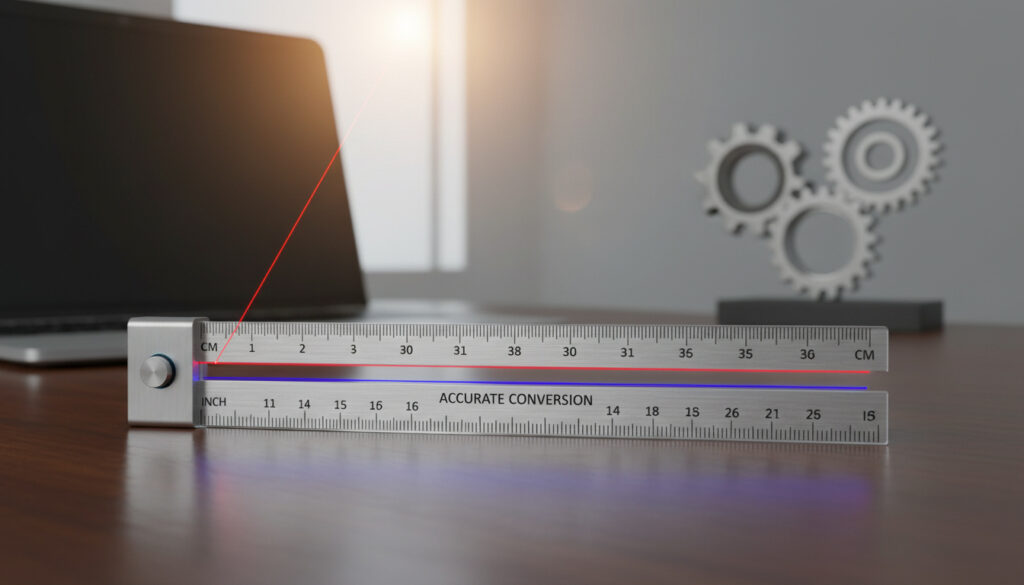
38 cm to Inches – Exact Conversion 14.96
38 centimeters equals exactly 14.9606299213 inches. This precise measurement reflects the internationally agreed conversion standard where one inch equals exactly 2.54 centimeters.
The conversion appears frequently in international commerce, manufacturing specifications, and consumer electronics, particularly when comparing European metric measurements with United States customary units. Understanding the exact relationship between these units prevents costly measurement errors in fields ranging from construction to fashion.
While many approximate 38 cm as 15 inches for quick mental calculations, the exact decimal value ensures precision in technical applications where tolerance matters.
What is 38 cm in inches?
- 38 cm corresponds closely to the width of a standard 15-inch laptop computer screen.
- European product specifications often list 38 cm dimensions, while U.S. retailers typically display the equivalent as 15 inches.
- Using the exact calculation prevents rounding errors that accumulate in engineering and manufacturing contexts.
- In clothing measurements, a 38 cm inseam translates to approximately 15 inches, though sizing varies by manufacturer.
- When laid against a metric ruler, 38 cm spans from the zero mark to the 38th graduation.
- Reverse conversion: 38 inches equals 96.52 centimeters, illustrating the non-symmetrical relationship between the units.
| Centimeters | Inches (Exact) | Inches (Rounded) | Feet |
|---|---|---|---|
| 1 cm | 0.3937007874 | 0.39″ | 0.033 ft |
| 10 cm | 3.937007874 | 3.94″ | 0.33 ft |
| 25 cm | 9.842519685 | 9.84″ | 0.82 ft |
| 30 cm | 11.811023622 | 11.81″ | 0.98 ft |
| 38 cm | 14.9606299213 | 14.96″ | 1.25 ft |
| 40 cm | 15.7480314961 | 15.75″ | 1.31 ft |
| 50 cm | 19.6850393701 | 19.69″ | 1.64 ft |
How do you convert cm to inches?
Converting centimeters to inches requires applying a fixed mathematical relationship established by international treaty in 1959. The process works whether using a calculator or performing manual calculations.
The Standard Formula
The conversion relies on two equivalent formulas. First, divide the centimeter value by 2.54. Alternatively, multiply by 0.3937007874. Both methods yield identical results because 0.3937007874 equals 1 divided by 2.54. Online calculators automate this process, but understanding the underlying mathematics ensures accuracy when digital tools are unavailable.
Step-by-Step Manual Calculation
To convert 38 cm manually, divide 38 by 2.54. This produces 14.9606299213 inches. For verification, multiply 14.96 by 2.54—this returns approximately 38, confirming accuracy. Another approach uses the approximation of 2.5 cm per inch as a mental check: 38 divided by 2.5 equals 15.2, slightly higher than the true value, indicating the need for downward adjustment. Visual guides demonstrate this alignment using dual-scale rulers.
After dividing 38 by 2.54 to get 14.96, verify by multiplying back: 14.96 inches × 2.54 cm/inch ≈ 38 cm. This cross-check confirms conversion accuracy within 0.04 millimeters.
What sizes are close to 38 cm in inches?
Understanding measurements near 38 cm provides useful context for visual estimation and comparative shopping. Several common reference points fall within this range.
Comparison with Standard Sizes
Thirty centimeters converts to 11.81 inches, while 40 centimeters equals 15.75 inches. Thus, 38 cm falls between these values, closer to the 40 cm mark. Conversion tables show that 35 cm translates to 13.78 inches, placing 38 cm roughly midway between 35 cm and 40 cm in terms of visual length.
Feet and Inches Conversion
Thirty-eight centimeters equals 1.2467 feet, or precisely 1 foot and 2.96 inches. This measurement appears in furniture dimensions, particularly for depth specifications of cabinets and shelving units. Specialized converters provide these dual-unit outputs automatically.
A standard 15-inch laptop typically measures approximately 38 cm in width. This makes the conversion immediately relevant when comparing computer bag specifications or desk space requirements between European and American retail listings.
Development of the Conversion Standard
The relationship between centimeters and inches stems from separate historical measurement systems that converged through international agreement.
- : France officially adopts the metric system, establishing the meter and its subdivisions including the centimeter.
- : The United Kingdom standardizes imperial units through the Weights and Measures Act, defining the inch.
- : International agreement fixes the inch at exactly 25.4 millimeters (2.54 centimeters), creating the current conversion standard maintained by metrology institutes worldwide.
Exact Values vs. Practical Rounding
Different contexts demand different levels of precision when converting 38 cm to inches.
| Established Precision | Practical Considerations |
|---|---|
| Mathematically exact: 14.9606299213 inches (repeating) | Most tape measures display only 1/16 or 1/32 inch increments |
| Standard engineering: 14.96 inches (two decimal places) | Woodworking typically tolerates 1/8 inch (0.125″) variance |
| Consumer rounding: 15 inches | Acceptable for clothing sizes and rough estimates |
| Legally defined factor: 1 inch = 2.54 cm exactly | No uncertainty exists in the conversion factor itself |
Why Convert Between These Units?
Global manufacturing and international e-commerce drive the need for precise conversion between metric and imperial systems. A product manufactured in Germany at 38 cm width must fit American shelving standardized in inches. Educational resources emphasize these conversions in mathematics curricula, linking to practical Grade 3 Math Worksheets – Free Printable PDFs with Answer Keys for foundational learning.
Rounding 38 cm to 15 inches creates a 0.04-inch error. In precision manufacturing, this exceeds typical tolerances for machined parts, which often require accuracy within 0.001 inches.
Medical devices, automotive parts, and construction materials all require exact dimensional translation. A discrepancy of even 0.04 inches—the difference between 14.96 and 15—can determine whether precision components fit properly within mechanical assemblies.
Standards and Authority
The conversion factor derives from internationally recognized standards bodies.
The yard is defined as exactly 0.9144 meters, making the inch exactly 25.4 millimeters. This definition was agreed upon by the United States, Canada, Australia, New Zealand, and South Africa in 1959.
National Institute of Standards and Technology (NIST)
Length conversions between metric and imperial units rely on exact mathematical relationships established through international treaty, not approximate ratios.
International Organization for Standardization (ISO 80000-1)
Global conversion databases reference these standards to ensure consistent results across platforms.
Summary
Thirty-eight centimeters converts to exactly 14.9606299213 inches using the standard factor of 2.54 centimeters per inch. While 15 inches serves as a convenient approximation, the precise value of 14.96 inches ensures accuracy in technical and commercial applications. Understanding this conversion facilitates navigation between metric and imperial systems in global contexts. For additional measurement contexts involving height and scale, see the La Grande Roue de Montreal – Height Tickets Location Guide.
Frequently Asked Questions
Why convert cm to inches?
International trade and manufacturing require conversion between metric (cm) and imperial (inches) systems. Products made in Europe often list dimensions in centimeters, while U.S. standards use inches.
What is 1 cm in inches?
One centimeter equals exactly 0.3937007874 inches. This is the inverse of 2.54, the number of centimeters in one inch.
Is 38 cm exactly 15 inches?
No. 38 cm equals 14.96 inches, which is 0.04 inches less than 15. The difference equals approximately one millimeter.
38 cm to inches and feet?
Thirty-eight centimeters equals 1.25 feet, or precisely 1 foot and 2.96 inches.
How precise is the 2.54 cm standard?
The 2.54 cm per inch factor is legally exact and internationally agreed upon since 1959. There is no tolerance or variation in this standard.
More related posts
 Lord of the Rings Characters – Alphabetical List with Actors
 How to Remove Duplicates in Google Sheets
 Car Rental Fort Myers: Guide to RSW Airport & City Locations
 Blue Jays Play by Play: Live Updates, Announcers & How to Listen
 William Cloutier: Biography, Career, Songs, and Personal Life
 Alberta Forever Canada Petition: Results & Next Steps
 Doug Ford Speed Cameras – Ontario Ban Stands Amid Debate
 Ray Dalio: Net Worth, Principles, and How He Got Rich