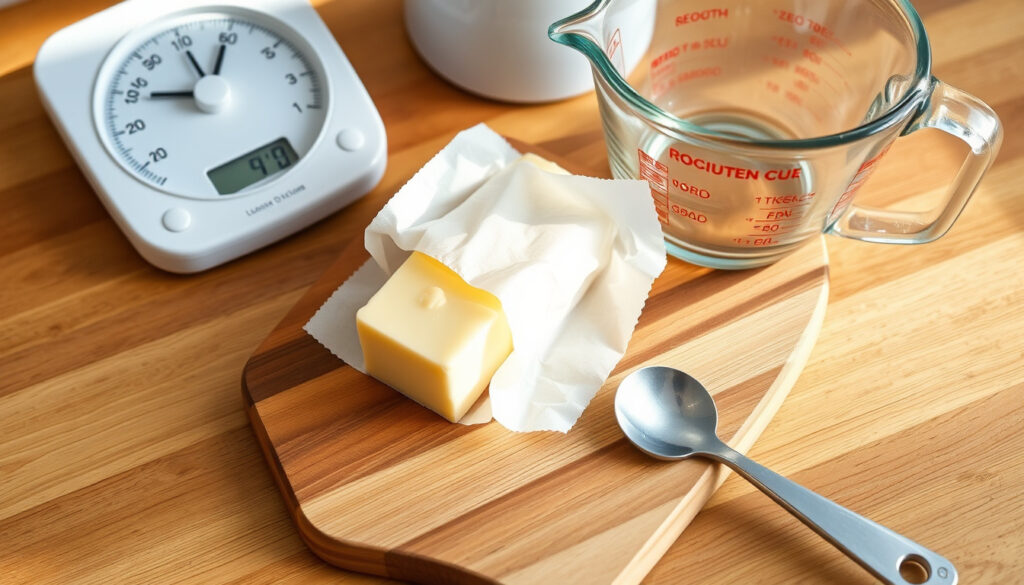
How Much Is a Stick of Butter? Grams, Cups, Tablespoons
You’re following a recipe from a US food blog, and it calls for “1 stick of butter.” If you grew up outside the US, that phrase might as well be in code. We’ll break down exactly how much a stick of butter weighs in grams, how it converts to cups and tablespoons, and clear up the metric confusion that trips up bakers worldwide.
1 stick of butter in grams: 113 grams ·
1 stick of butter in tablespoons: 8 tablespoons ·
1 stick of butter in cups: 1/2 cup ·
1 stick of butter in ounces: 4 ounces
Quick snapshot
- 1 stick = 113 grams (4 oz) (Land O’Lakes – US dairy cooperative)
- 1 stick = 1/2 cup = 8 tablespoons (KitchenAid – home appliance manufacturer)
- 2 sticks = 1 cup = 226 grams (Erren’s Kitchen – culinary blog)
- The exact historical origin of the 1/4‑pound stick size is not definitively documented. (KitchenAid)
- Gram weights vary slightly (113–115 g) across brands due to moisture content (KitchenAid).
- The exact origin of tablespoon markings on wrappers is not clearly recorded. (KitchenAid)
- Early 1900s: US butter packaging standardizes around 1‑lb blocks. (Baking Like a Chef – baking conversion resource)
- Mid‑20th century: Quarter‑pound sticks become common with tablespoon markings. (Baking Like a Chef – baking conversion resource)
- Today: USDA lists 113 g as the official weight for one stick (Baking Like a Chef – baking conversion resource).
- For accuracy, weigh butter in grams.
- Use wrapper markings for precise tablespoon cuts.
- Freeze extra sticks for later use.
Two measurement systems meet in your kitchen: weight and volume. Here’s how the US stick standard lines up.
| Label | Value |
|---|---|
| US stick weight | 113 grams (4 ounces) (Land O’Lakes) |
| US stick volume | 1/2 cup (8 tablespoons) (KitchenAid) |
| Australian block | 250 grams (typical) (Erren’s Kitchen) |
| European block | 200–250 grams (varies) (Baking Like a Chef) |
| Sticks per pound | 4 sticks (Land O’Lakes) |
No matter which unit your recipe uses, the math is consistent – and it all starts with the quarter‑pound stick.
| Sticks | Grams | Cups | Tablespoons | Teaspoons | Ounces |
|---|---|---|---|---|---|
| 1 | 113 | 1/2 | 8 | 24 | 4 |
| 1/2 | 57 | 1/4 | 4 | 12 | 2 |
| 1/4 | 28 | 2 tbsp | 2 | 6 | 1 |
| 2 | 226 | 1 | 16 | 48 | 8 |
| 3 | 339 | 1½ | 24 | 72 | 12 |
| 4 (1 lb) | 453 | 2 | 32 | 96 | 16 |
| ⅓ | 38 | ⅓ cup | 5⅓ | 16 | 1⅓ |
| ⅔ | 76 | ⅔ cup | 10⅔ | 32 | 2⅔ |
The pattern is clear: stick count divided by two gives you cups, and multiplying by eight gives you tablespoons.
What is 1 stick of butter in grams?
USDA standard weight for a butter stick
- According to the Land O’Lakes (US dairy cooperative), one stick of butter weighs 113 grams (4 ounces).
- This is also confirmed by Erren’s Kitchen (culinary blog), which lists 113.4 g for a stick.
- The Baking Like a Chef (baking conversion resource) also uses 113 g.
That 113 g figure comes from the US quarter‑pound standard. One pound (453.6 g) divided by four equals 113.4 g – not a round metric number, but the exact legal weight for US stick butter. The KitchenAid (home appliance manufacturer) rounds up to 115 g for simplicity, but the USDA standard is unequivocal: 113 g.
Many metric‑minded bakers assume a stick is 125 g because it’s a neat number. But US butter is sold by the pound, not by the 100 g block. 125 g would be about 10% over the true weight – enough to throw off a delicate pastry.
Why 113 grams and not 125 grams
- A US quarter‑pound = 113.4 g exactly, per the Erren’s Kitchen (culinary blog) conversion chart.
- In contrast, Australian and New Zealand butter blocks are typically 250 g (half a pound) and European blocks range 200–250 g.
The misconception arises because 125 g is half of 250 g, a common block size outside the US. But a US stick is half of a half‑pound – a quarter‑pound – not half of a 250 g block. The implication: if a US recipe says “stick,” measure 113 g, not 125 g.
Is 1 stick of butter 1 cup?
Stick to cup conversion
- 1 stick = 1/2 cup (KitchenAid)
- 2 sticks = 1 cup (Land O’Lakes)
- 1/2 stick = 1/4 cup (Baking Like a Chef)
Half cup vs one cup confusion
The most frequent mistake: reading “1 stick” as a full cup. A stick is exactly half a cup. A recipe calling for “1 cup butter” means 2 sticks. Erren’s Kitchen (culinary blog) notes that many beginner bakers double the butter when they use sticks, leading to greasy results.
The pattern is consistent: stick count ÷ 2 = cups. So 3 sticks = 1½ cups, 4 sticks = 2 cups. Memorize that ratio and you’ll never second‑guess a recipe again.
How many tablespoons are in a stick of butter?
Tablespoon markings on wrapper
- 1 stick = 8 tablespoons (Land O’Lakes)
- Butter wrappers are pre‑marked at each tablespoon, so you can cut exactly what you need (KitchenAid).
Half stick conversions
- 1/2 stick = 4 tablespoons (Baking Like a Chef)
- 1/4 stick = 2 tablespoons (Erren’s Kitchen)
- 1 tablespoon of butter weighs about 14 g (Savor the Best – cooking PDF)
Why this matters: when a recipe lists “4 tablespoons butter,” you can cut a half stick. No guesswork, no smearing butter into a measuring spoon. The wrapper itself does the math.
The catch: those wrapper markings are a convenience, not a legal standard — but every major US dairy brand uses them.
Confirmed facts vs what’s unclear
Confirmed facts
- A US butter stick weighs 113 g (4 oz). (Land O’Lakes)
- One stick equals 1/2 cup or 8 tablespoons. (KitchenAid)
- Two sticks equal 1 cup or 226 g. (Erren’s Kitchen)
What’s unclear
- The exact historical origin of the 1/4‑pound stick size is not definitively documented.
- Some brands may vary slightly in weight due to moisture content; 113 g is the USDA standard.
- The precise reason tablespoon markings became standard on wrappers is not recorded.
What the experts say
“One stick of butter equals ½ cup, 8 tablespoons, 4 ounces, or about 113 grams.”
— Land O’Lakes (US dairy cooperative)
“Our butter conversion chart allows you to convert sticks of butter to cups, grams, ounces, and tablespoons.”
— Baking Like a Chef (baking conversion resource)
A conversion chart only helps if you know which standard it follows. The US stick is unique, and the experts agree on the numbers.
For the home baker outside North America, the decision is simple: invest in a kitchen scale and treat 113 g as your go‑to weight for one stick. Guessing between 100 g, 125 g, and 250 g will only lead to dense cakes or greasy cookies – and a scale removes the guesswork entirely.
Related reading: Kitchen Backsplash Trends 2025 · Pilon de Poulet au Four – Cooking Time and Temperature Guide
Frequently asked questions
Can I use a stick of butter straight from the fridge for baking?
Yes, but cold butter is harder to cream with sugar. Let it sit at room temperature for 30–45 minutes before using for most baking.
What if my recipe calls for melted butter – do I measure before or after melting?
Measure before melting. The volume changes during melting due to air incorporation. Melt after measuring.
How do I soften a stick of butter quickly?
Cut it into small cubes and leave it at room temperature for 15 minutes, or use a microwave at 10‑second intervals on low power.
Is salted or unsalted butter better for baking?
Unsalted is preferred because it lets you control the salt level. If using salted, reduce added salt by ¼ teaspoon per stick.
How long does a stick of butter last in the fridge?
Properly wrapped, it stays fresh for 1–2 months past the printed date. Check for off smells or mold.
Can I freeze a stick of butter?
Yes. Wrap tightly in plastic wrap or foil and freeze for up to 6–9 months. Thaw in the fridge before use.
More related posts
 Telus Cell Phone Plans 2025: Pricing, Deals & Comparison
 Salut Bonjour En Direct – Hosts Schedule Streaming Guide
 Kasperi Kapanen 2025: Allegations, salary, and NHL career
 Siberian Cat: Guide to Temperament, Care & Allergies
 Joseph Baena: Biography, Family & Arnold Schwarzenegger
 38 cm to Inches – Exact Conversion 14.96
 Amazon Canada Online Shopping: Switch Regions, Ship & Save
 What Is a Cashier’s Check? Complete Guide, Costs & Risks