38 cm to Inches – Exact Value, Formula and Tips
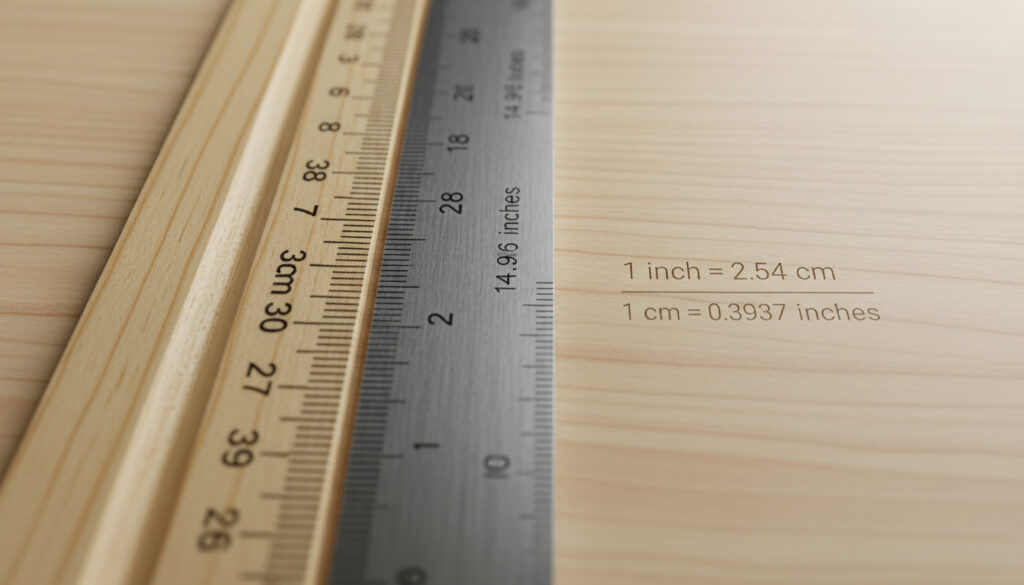
Thirty-eight centimeters converts to exactly 14.9606299213 inches, a precise measurement established by the international definition of the inch as exactly 2.54 centimeters. This conversion factor, standardized in 1959, ensures uniformity across scientific, commercial, and industrial applications worldwide.
While the exact decimal extends to ten places, most practical applications round this figure to 14.96 inches or approximately 15 inches. Understanding when to use the precise value versus the rounded approximation depends entirely on the required tolerance of the specific task, from engineering specifications to everyday shopping.
How Many Inches is 38 cm?
- Thirty-eight centimeters equals precisely 14.9606299213 inches when divided by the standard 2.54 cm per inch.
- The conversion relies on the 1959 International Yard and Pound Agreement, which defined the inch as exactly 2.54 centimeters.
- For quick estimation, 38 cm rounds to 15 inches, producing a negligible error of approximately 0.04 inches.
- In feet and inches, 38 cm translates to exactly 1 foot and 2.96 inches.
- Manufacturers commonly encounter this measurement when specifying 15-inch laptop screens or display diagonals.
- Construction and textile industries frequently convert 38 cm to inches for materials crossing metric and imperial markets.
| Centimeters | Inches (Exact) | Inches (Rounded) |
|---|---|---|
| 30 cm | 11.8110236220 in | 11.81 in |
| 35 cm | 13.7795275591 in | 13.78 in |
| 36 cm | 14.1732283465 in | 14.17 in |
| 37 cm | 14.5669291339 in | 14.57 in |
| 38 cm | 14.9606299213 in | 14.96 in |
| 39 cm | 15.3543307087 in | 15.35 in |
| 40 cm | 15.7480314961 in | 15.75 in |
| 45 cm | 17.7165354331 in | 17.72 in |
How to Convert CM to Inches (Formula)
The Mathematical Foundation
The conversion rests on a single, unvarying constant: one inch equals exactly 2.54 centimeters. This definition, established by international treaty and maintained by national standards bodies including the National Institute of Standards and Technology, provides the foundation for all metric-to-imperial length conversions. To convert any centimeter value to inches, divide by 2.54.
Always use 2.54 exactly, not 2.5 or 2.6. Rounding the conversion factor itself introduces cumulative errors in larger measurements. For 38 cm, using 2.5 would yield 15.2 inches—an error of nearly 0.24 inches.
Step-by-Step Calculation
To convert 38 cm manually: First, write down the measurement (38). Next, divide by 2.54. The calculation 38 ÷ 2.54 produces 14.9606299213. For scientific or engineering purposes, retain all decimal places. For everyday use, rounding to two decimal places (14.96 inches) or even whole numbers (15 inches) suffices. Online verification tools confirm this result instantly.
38 cm in Inches and Feet
Decimal Inches
Thirty-eight centimeters equals precisely 14.9606299213 inches. This decimal representation emphasizes the exactness of the conversion, critical when tolerances are tight. In woodworking or machining, where a millimeter matters, referencing the full decimal prevents fitting issues.
Feet and Inches Combined
For contexts using feet, 38 cm converts to approximately 1.247 feet. More practically, this equals 1 foot and 2.96 inches. Construction professionals might express this as 1′-2.96″ on blueprints. Conversion calculators often display both formats simultaneously for convenience.
Quick CM to Inches Calculator
Numerous browser-based converters handle the 38 cm calculation instantly. These tools use the same 2.54 divisor but eliminate human arithmetic errors. Worldometers provides one such utility, displaying results to multiple decimal places.
Approximately 38 cm as exactly 15 inches works for casual conversation but introduces a 0.039-inch discrepancy. In medical device manufacturing or aerospace components, this margin exceeds acceptable tolerances. Always verify precision requirements before rounding.
Mobile applications and video tutorials offer visual guidance for students learning dimensional analysis. These resources demonstrate why 38 cm falls just short of the 15-inch mark, helping users understand the relationship between metric and imperial scales.
Exact Value vs. Practical Approximation
Established Fact
- 38 cm = 14.9606299213 inches exactly
- Conversion factor 2.54 cm/inch is a defined constant
- Defined by 1959 International Yard and Pound Agreement
- NIST recognizes 1 inch as exactly 25.4 mm
Contextual Variables
- Appropriate rounding depends on industry tolerances
- 15-inch approximation acceptable for screens, rough carpentry
- Exact decimal required for engineering specs
- Measurement uncertainty depends on original 38 cm precision
Where 38 cm Appears in Daily Life
Thirty-eight centimeters translates to roughly 15 inches, a dimension frequently encountered in consumer electronics. Laptop manufacturers often advertise 15-inch screens, though the actual diagonal measurement typically measures 38.1 cm (15 inches exactly). A 38 cm measurement also appears in clothing specifications, particularly for sleeve lengths or waistbands in European sizing converted for American markets.
Construction materials occasionally reference 38 cm widths for lumber or paneling when importing metric stock to imperial-based markets. Mathematical references confirm this conversion proves essential for international shipping, where container dimensions might list internal widths in centimeters while destination requirements specify inches.
La Grande Roue de Montreal – Height Tickets Location Guide provides an example of tourism applications where metric heights require imperial translation for diverse visitor demographics.
Standards Behind the Conversion
One inch is defined as exactly 2.54 centimeters according to the 1959 International Yard and Pound Agreement between the United States, United Kingdom, Canada, Australia, New Zealand, and South Africa.
The National Institute of Standards and Technology upholds the definition of 1 inch as precisely 25.4 millimeters for all official US measurements, ensuring consistency across scientific and commercial applications.
Converting 38 cm to Inches
Thirty-eight centimeters equals exactly 14.9606299213 inches, derived from dividing by the international standard of 2.54 centimeters per inch. While precise calculations matter in technical fields, rounding to 14.96 inches or approximately 15 inches serves most everyday purposes. Understanding this conversion facilitates navigation between metric and imperial systems, from Grade 3 Math Worksheets – Free Printable PDFs with Answer Keys to professional engineering specifications.
Common Questions About 38 cm Conversions
Can I round 38 cm to 15 inches?
Yes, for most practical purposes including screen sizes and rough measurements, rounding 38 cm to 15 inches introduces only a 0.04-inch error. However, precision manufacturing requires the exact 14.96 inches.
Is 38 cm exactly 15 inches?
No. Thirty-eight centimeters equals 14.9606299213 inches. Exactly 15 inches equals 38.1 centimeters. The difference measures approximately 0.04 inches or one millimeter.
What is 38 cm in feet and inches?
Thirty-eight centimeters equals 1.247 feet, or precisely 1 foot and 2.96 inches. Construction notation typically writes this as 1′-2.96″.
How do I convert inches back to centimeters?
Multiply the inch measurement by 2.54. For example, 14.96 inches × 2.54 = approximately 38 cm. Reverse calculations use the inverse of the division factor.
Why does the conversion use 2.54 specifically?
The 1959 International Yard and Pound Agreement defined the inch as exactly 2.54 centimeters to standardize imperial units with the metric system. NIST maintains this definition as exactly 25.4 millimeters.
What common objects measure 38 cm?
Fifteen-inch laptop screens (approximately), standard ruler lengths, certain cooking pans, and short shoe sizes often approximate 38 cm in diagonal or length measurements.
Where is the 38 cm to inches conversion most critical?
International commerce, medical device manufacturing, and construction materials sourcing require this conversion when specifications cross between metric-dominant and imperial-dominant markets.
More related posts
 CRA Payroll Calculator 2025: Free Online Deductions Tool
 Gabby Barrett: Biography, Husband, Net Worth and Kids
 Black Ops 7 Release Date – Confirmed Launch Details
 What Is a Cashier’s Check? Complete Guide, Costs & Risks
 One Life (2023 Film) – Nicholas Winton True Story & Cast
 Liam Hemsworth: Biography, Movies, Divorce, and Current Relationship
 Fortnite.com/2fa – How to Enable 2FA on Fortnite
 NHL Schedule 2025-26: Start Date, Release & Rangers