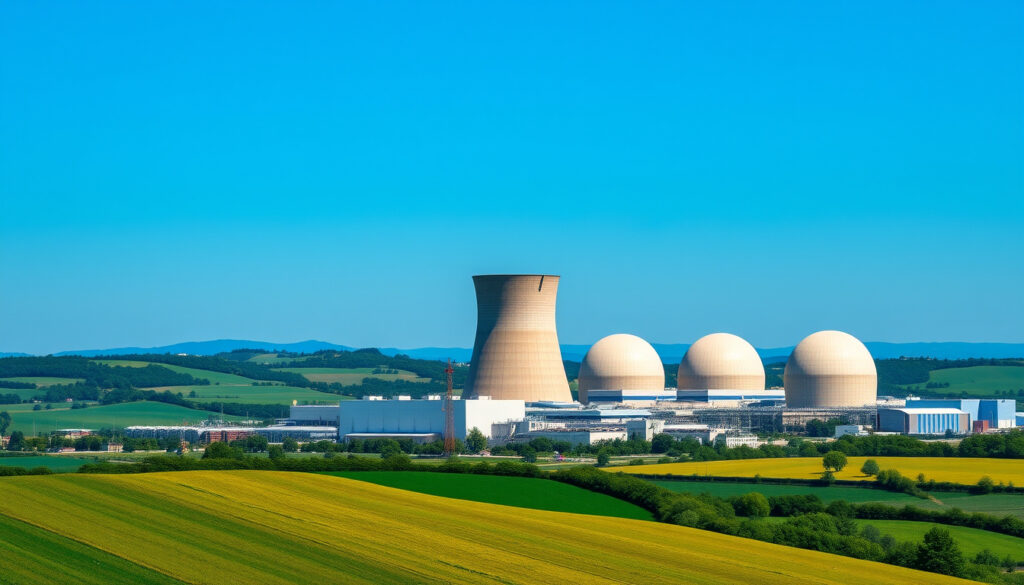
Is Nuclear Energy Renewable? Facts, France & Debate
Few debates in energy policy twist as sharply as the one around nuclear power. Supporters call it a climate savior; critics point to finite uranium supplies and stubborn waste problems. The question “is nuclear energy renewable?” doesn’t have a clean answer — it hinges on who you ask, where you look, and what they stand to gain. France’s sprawling nuclear program offers a useful test case: it reprocesses nearly all its spent fuel, cuts waste volume dramatically, and still insists it’s not “renewable” under international definitions.
France’s nuclear electricity share: 70% ·
Nuclear waste recyclability: 96% ·
Nuclear emissions profile: zero-emission source ·
Renewable definitions exclude: nuclear power
Quick snapshot
- Nuclear uses finite uranium (World Nuclear Association)
- France recycles 96% of spent fuel at La Hague (World Nuclear News)
- Global renewable definitions exclude nuclear (World Nuclear Association)
- Whether “sustainable” and “renewable” mean the same thing to regulators (World Nuclear Association)
- How much uranium France stockpiles versus reuses (World Nuclear News)
- Whether global markets will treat nuclear as green under future taxonomies (World Nuclear Association)
- France’s new energy law: passed by decree on 13 February 2026 (CarbonCredits.com)
- Cigéo repository construction may begin 2028, target 2050 completion (Carnegie Endowment)
- France targets 650–693 TWh decarbonized electricity by 2035 (CarbonCredits.com)
- Six new EPR reactors confirmed; eight more optional (Euronews)
Four data points, one pattern: France runs the world’s most aggressive nuclear recycling program and still does not call its power “renewable.”
| Metric | Value |
|---|---|
| Top nuclear power country | France (nearly 75%) |
| Waste recyclability claim | 96% (Orano) |
| Emissions profile | Zero-emission |
| Renewable status per definitions | Excluded |
The table above shows how France dominates nuclear electricity production globally while maintaining the world’s highest waste recyclability rate — yet still falls outside the renewable category by legal definition.
How eco-friendly is nuclear energy?
Nuclear power generates electricity without burning fossil fuels, which means near-zero carbon emissions during operation. In December 2017, a French President stated nuclear is “the most carbon-free way to produce electricity with renewables,” positioning it alongside solar and wind as a low-carbon backbone (World Nuclear Association). France’s 58 reactors supplied roughly 70% of the country’s electricity in 2025, part of a mix that delivered 97% low-carbon power overall (CarbonCredits.com).
That zero-emission credential sits uneasily with reality on the ground. The mining and enrichment of uranium consumes energy, and spent fuel stays radioactive for tens of thousands of years. Even France’s world-leading recycling program cannot eliminate the 4% of high-level waste that current techniques cannot process — that material sits in dry casks awaiting eventual geological disposal (Carnegie Endowment). The gap between “zero-emission at the stack” and “clean all the way through” is where the eco-friendliness debate gets messy.
Is nuclear energy clean?
Whether nuclear qualifies as “clean” depends on which life-cycle stage you weight most heavily. During operation, it emits no CO₂, no sulfur dioxide, and no particulate matter — a major advantage over coal or gas plants. The World Nuclear Association notes that nuclear produces among the lowest life-cycle greenhouse gas emissions per kilowatt-hour of any mainstream electricity source, comparable to wind and lower than solar in some assessments (World Nuclear Association).
The catch is mining and decommissioning. Uranium extraction involves significant land disturbance and energy input, while decommissioning a reactor costs billions and takes decades. Critics argue that these upstream and downstream phases mean nuclear is “dirtier than its advocates admit.” Proponents counter that no energy source is entirely footprint-free, and nuclear’s advantage — it produces enormous power from tiny amounts of fuel — makes the trade-offs worth accepting.
Is nuclear energy sustainable?
Sustainability hinges on whether a resource can be replenished faster than it is consumed. Nuclear fails this test because uranium is a finite mineral with known reserves that will eventually be depleted. France’s recycling strategy extends the life of its fuel supply dramatically — recovering uranium and plutonium for reuse in mixed-oxide (MOX) fuel — but it does not create new uranium atoms (World Nuclear News).
Bruno Le Maire, France’s Economy Minister, announced the continuation of the recycling strategy beyond 2040, extending plant operations and planning new MOX and processing facilities (World Nuclear News). The move acknowledges that France is stretching its uranium stocks, not replacing them. Long-term sustainability, then, depends on two unknowns: global uranium reserves and the eventual scaling of fast breeder reactors that could theoretically multiply fuel availability by an order of magnitude.
Nuclear is clean during operation but relies on finite uranium. France’s recycling buys time, not eternity — and time runs out without next-generation reactor technology.
What does Elon Musk say about nuclear energy?
Elon Musk has made his views on nuclear power inconsistent over the years. He has called pushing nuclear “super dumb” in social media posts, arguing that solar and battery storage represent a better long-term bet for humanity’s energy needs. At the same time, he has acknowledged nuclear’s merit as a low-carbon baseload technology that does not depend on weather patterns the way wind and solar do (World Nuclear Association). The apparent contradiction — rejecting nuclear expansion while calling it useful — reflects a broader tension in the clean energy debate.
Elon Musk calls nuclear push Super Dumb
Musk’s sharpest language has targeted governments that prioritize nuclear construction over faster-deploying renewables. His core argument: solar and wind are now cheap enough that building new nuclear plants is economically irrational when faster, cheaper alternatives exist. Battery storage, he suggests, can handle the intermittency problem that nuclear advocates use to justify baseload power.
The counterargument from nuclear supporters is that Musk underestimates grid reliability requirements. Renewables without storage cannot deliver the constant demand profile that industrial economies need. France’s experience — exporting cheap nuclear electricity to neighboring European countries while maintaining 97% low-carbon supply — suggests the baseload case is not merely theoretical (Stanford University).
Musk’s dual stance — useful for grids but “super dumb” to expand — mirrors a real fault line in energy policy: whether nuclear’s reliability advantage justifies its capital costs and finite fuel supply.
What is renewable energy?
Renewable energy refers to sources that replenish naturally on a human timescale — sunlight, wind, water, geothermal heat, and biomass. The defining characteristic is that using them does not deplete a finite stock. Solar panels convert sunlight that will keep arriving tomorrow; wind turbines harvest air currents that refill continuously; hydropower draws from precipitation that cycles through the atmosphere.
What are the 7 types of renewable energy?
The seven mainstream categories are solar (photovoltaic and thermal), wind (onshore and offshore), hydropower, geothermal, biomass, tidal, and wave energy. Each has a different profile in terms of cost, scalability, and geographic requirements. Nuclear energy does not appear on any standard list because it relies on uranium — a mineral extracted from the ground that behaves more like coal or natural gas than sunlight.
The distinction matters legally in many jurisdictions. The European Union’s taxonomy for sustainable activities, for example, explicitly excludes nuclear from the “renewable” category in some member states, though it may still qualify for “sustainable” or “transitional” labels. France has pushed back against this framing, with Prime Minister Sébastien Lecornu stating that the country needs both nuclear and renewables rather than choosing between them (Euronews).
Regulators treat “renewable” as a legal classification tied to inexhaustibility — nuclear’s reliability and low carbon footprint cannot override the finite uranium supply that disqualifies it.
What are five disadvantages of nuclear energy?
Nuclear power’s drawbacks are real and, in some cases, irreversible. Five stand out in the debate about whether it deserves a place alongside renewables in a decarbonized grid.
Safety concerns
High-profile accidents at Chernobyl, Three Mile Island, and Fukushima have imprinted nuclear risk on public consciousness. Even without a major incident, reactor operations produce radioactive materials that require stringent containment. France’s 58 reactors maintain strong safety records, but the consequences of failure are severe enough that no amount of engineering can reduce the risk to zero.
Waste issues
France’s recycling program recovers 96% of used fuel for reuse, reducing waste volume by 75% (World Nuclear News). The remaining 4% — high-level waste incompatible with current processing — requires safe storage for geological timeframes. The Cigéo repository project, whose Déclaration d’utilité publique was published on 8 July 2022, aims to house this material beginning around 2030, with full operations targeted for 2050 (Wikipedia).
Finite fuel
Uranium reserves are concentrated in a handful of countries, with Kazakhstan, Canada, and Australia leading production. Unlike solar or wind, nuclear cannot claim energy independence in any meaningful sense. France imports uranium from former colonial territories and Central Africa, linking its electricity supply to global mining markets.
High upfront costs and long construction timelines
Building a new nuclear plant costs billions and takes 15–20 years from permitting to commissioning. The six new EPR reactors France confirmed under its 2026 energy law represent a multi-decade commitment (Euronews). By comparison, utility-scale solar can be permitted and built in two to three years.
Public opposition and regulatory barriers
Even in France, where nuclear enjoys broad political support, the anti-nuclear sentiment in neighboring Germany shows how quickly public opinion can shift. Regulatory hurdles, combined with vocal activist campaigns, add uncertainty to any new nuclear project.
Upsides
- Zero-emission during operation — comparable to wind and solar on life-cycle CO₂
- Reliable baseload power independent of weather
- France recovers 96% of spent fuel, reducing waste volume by 75%
- 58 reactors supply 70% of French electricity from a small geographical footprint
Downsides
- Finite uranium fuel — not inexhaustible
- 4% of high-level waste cannot be recycled; requires geological storage for millennia
- Construction costs billions; timelines stretch 15–20 years
- Consequences of accidents are severe and long-lasting
The tension between nuclear’s reliability and its long-term waste liability forces policymakers into trade-offs that no amount of recycling efficiency can fully resolve.
Is 96% of nuclear waste recyclable?
France’s nuclear program holds the world’s highest recycling rate: Orano reprocesses 96% of used fuel at its La Hague and Melox facilities, which have operated for over 50 years (Orano). The recovered uranium and plutonium go into MOX fuel, which currently generates roughly 10% of France’s nuclear electricity. Operators say that share could climb to 25–40% with expanded recycling (World Nuclear News).
What country gets nearly 75% of its electricity from nuclear power?
France gets approximately 70% of its electricity from nuclear power — not quite 75%, but close enough that the statistic appears frequently in simplified accounts (CarbonCredits.com). No other country comes close to that share. The next-highest nuclear electricity producers — the United States and China — generate roughly 15–20% of their power from reactors. France’s dependence makes it uniquely relevant to the renewable debate: if nuclear were to be classified as renewable, France would already be 70% of the way there.
The recycling figure adds nuance. France’s approach means it generates dramatically less spent fuel per unit of electricity than countries that store used fuel without reprocessing. The 75% waste volume reduction is not a global average — it is a French specialty. In the United States, the picture is very different: most spent fuel sits in dry storage at reactor sites, with no federal repository operational since Yucca Mountain was effectively shelved.
The implication for the renewable classification question: France’s recycling model extends the useful life of its uranium supply, but it does not make nuclear infinite. No amount of reprocessing changes the fundamental physics — uranium atoms are consumed, not regenerated. France is consuming its fuel more efficiently, not sustainably in the renewable sense.
France’s 96% recycling rate is a genuine achievement in resource efficiency — but it addresses waste volume, not renewability. The uranium is still running out, just more slowly.
Is nuclear energy safe?
Nuclear safety has improved dramatically since the industry’s early decades. Modern reactor designs — including France’s EPR units and the next-generation small modular reactors in development — incorporate passive safety systems that shut down the reaction without human intervention in case of coolant failure. The International Atomic Energy Agency maintains strict inspection regimes that most operating countries follow.
That said, “safe” is a relative term. Radioactive materials require containment for geological timescales. Even low-level waste from hospitals and industry carries handling requirements that never fully go away. France’s Cigéo repository, once operational, will monitor waste for tens of thousands of years — a planning horizon that puts climate change itself in perspective (Wikipedia).
Is nuclear energy reliable?
Reliability is nuclear’s strongest card. A functioning reactor runs at 90–95% capacity factor, meaning it produces power roughly 90% of the time regardless of weather or season. Wind farms average 25–45% capacity factors; solar in northern Europe can drop to single digits in winter. For a grid that needs constant power — hospitals, data centers, steel mills — nuclear delivers reliability that intermittent renewables cannot match without storage.
France exports cheap nuclear electricity to neighboring European countries, demonstrating that nuclear can underpin a continental power trade while maintaining its own 97% low-carbon supply (Stanford University). This reliability premium is why Prime Minister Lecornu rejected the framing that France must choose between nuclear and renewables — the grid needs both, at least through 2030.
Is nuclear energy fossil fuel?
Nuclear energy is not a fossil fuel. It does not burn coal, oil, or natural gas. It does not emit CO₂ during operation, which is why climate-focused policymakers often group it with renewables in decarbonization scenarios. The International Energy Agency classifies it as a low-carbon energy source alongside wind and solar.
However, the absence of combustion does not make nuclear renewable. The distinction is straightforward: fossil fuels and nuclear both consume finite underground resources. They differ in their environmental footprints and waste products, but they share the fundamental characteristic of exhaustibility. A renewable source, by definition, draws on flows of energy that are replenished faster than they are used — sunlight, wind, water. Uranium does not regenerate on any human timescale.
Is nuclear energy good?
Whether nuclear is “good” depends on the criteria you apply. If the goal is rapid decarbonization of electricity grids, nuclear delivers — France’s 97% low-carbon electricity is proof. If the goal is minimizing long-term radioactive waste, nuclear requires careful management that extends centuries beyond the plants themselves. If the goal is energy independence, nuclear ties a country to uranium supply chains that run through a handful of producing nations.
Finance Minister Roland Lescure captured the emerging consensus in France: “We need to stop our internal family squabbling. We need both nuclear and renewables.” (CarbonCredits.com). That pragmatic position sidesteps the “renewable or not” classification debate and focuses on what the grid actually needs: firm, low-carbon power and scale-up of variable renewables in parallel.
Is nuclear energy the future?
France’s new energy law, passed by decree on 13 February 2026, suggests the answer is yes — for at least the next decade. The law boosts nuclear under the Multiannual Energy Programming framework through 2035, targets 60% electrification of total energy consumption by 2030, and confirms six new EPR reactors with eight more optional (CarbonCredits.com). Meanwhile, renewable unions expressed relief that there is no slowdown in tenders for solar, wind, offshore wind, and geothermal — but onshore wind upgrades face criticism as insufficient from industry heads.
The future for nuclear depends on whether it can solve its core problems: cost, speed, and waste. Small modular reactors, if they deliver on their promise of factory-built units deployable in under a decade, could change the cost and timeline equation. France’s recycling infrastructure, the world’s most advanced, shows that the waste problem is manageable — just not solvable on a renewable definition.
The implications extend beyond France: if nuclear cannot escape its finite-fuel designation, even the most efficient recycling programs will eventually hit a resource ceiling.
What is the most efficient renewable energy?
Efficiency in energy sources is measured differently depending on what you optimize for. Hydropower has the highest capacity factor of any electricity source — often above 90% — but is geographically constrained by water access. Nuclear has among the lowest life-cycle carbon emissions per kilowatt-hour, competitive with onshore wind and significantly lower than solar in some assessments. Among true renewables, hydropower and geothermal generally offer the highest capacity factors; solar and wind offer the lowest costs per megawatt-hour in sunny or windy regions.
If the question is “most efficient at decarbonizing a grid,” nuclear and hydropower compete strongly. If the question is “most efficient at delivering cheap, scalable power,” solar has won the cost curve over the past decade. The honest answer is that no single source dominates on every metric — which is why the most credible energy strategies combine nuclear, renewables, and storage rather than betting on a single winner.
““We need to stop our internal family squabbling. We need both nuclear and renewables.””
“"Thanks to this strategy, we will ultimately reduce the volume of nuclear waste by 75%"”
Related reading: Is Adolescence Based on a True Story · What Is a Good Internet Speed? Mbps Guide for UK Homes
Debates over nuclear power’s status often contrast it with the renewable energy definition, focusing on inexhaustible natural replenishment rather than fuel recycling efficiency.
Frequently asked questions
Is nuclear energy safe?
Nuclear power has strong safety records in countries like France, where 58 reactors operate under strict oversight. Modern designs add passive safety systems, but no technology eliminates all risk — and radioactive waste requires safe storage for geological timescales.
Is nuclear energy reliable?
Yes — nuclear runs at 90–95% capacity factor, independent of weather. France exports cheap nuclear electricity to Europe, demonstrating that it can underpin a reliable, low-carbon grid.
Is nuclear energy fossil fuel?
No. Nuclear does not burn fossil fuels and emits no CO₂ during operation. However, it still consumes finite uranium, placing it in the same exhaustibility category as fossil fuels — distinct from true renewables.
Is nuclear energy good?
Nuclear excels at delivering firm, zero-emission power at scale. Its downsides — finite fuel, waste management spanning millennia, high upfront costs — are serious but manageable with advanced programs like France’s.
Is nuclear energy the future?
France’s 2026 energy law bets on it — six new EPR reactors confirmed, electrification targets through 2035. The future depends on whether small modular reactors can solve nuclear’s cost and timeline problems.
What is the most efficient renewable energy?
Hydropower has the highest capacity factors; nuclear has among the lowest life-cycle carbon emissions. No single source dominates every metric, which is why the best grids combine multiple technologies.
More related posts
 Cliff Burton Death: Last Words, Royalties & Net Worth Revealed
 John Ternus: Net Worth, Salary, Career, and Apple CEO Succession
 Kevin Spacey: Oscar Winner to Allegations Fallout
 What to Do to Be Productive: Rules & Pillars Guide
 Scotiabank Car Loan Calculator 2025: Rates, Payments & Guide
 Diana Ross: Children, Relationships, and Life Facts
 Shabana Azeez: Ethnicity, Age, and HBO’s The Pitt Overview
 Films avec Zac Efron – Complete Filmography and Best Movies