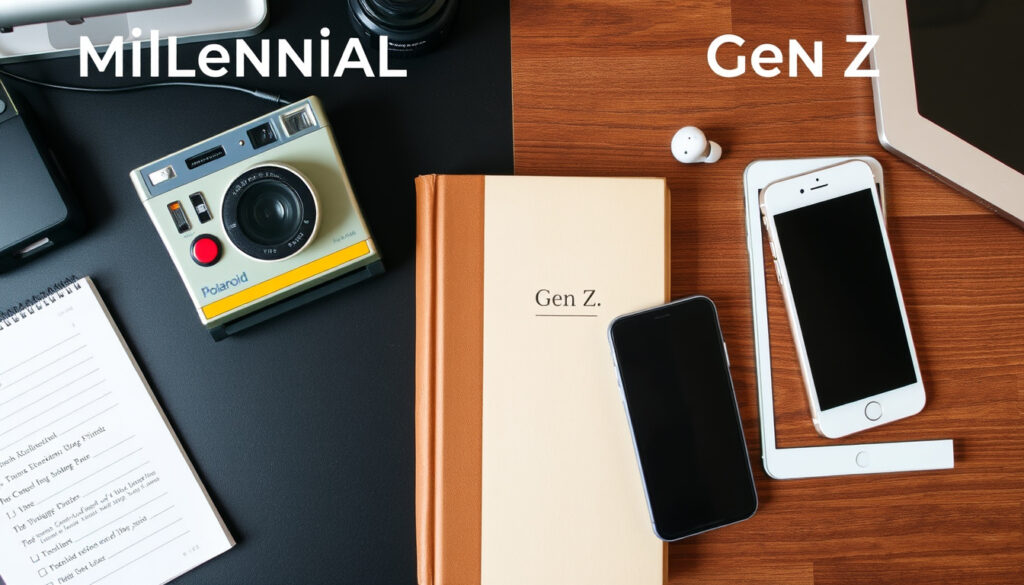
Millennial Generation: Years, Traits, and Gen Z Differences
If you were born between 1981 and 1996, you belong to the Millennial generation — a cohort that grew up with dial‑up internet and graduated into a world of smartphones. This group, also called Generation Y, now makes up the largest adult generation in the United States.
Millennial birth years: 1981–1996 (Pew Research) ·
Largest generation of adults: 2019 (Britannica) ·
Oldest Millennials turn: 43 in 2024
Quick snapshot
- Born 1981–1996 per Pew Research Center (nonpartisan think tank)
- Surpassed Baby Boomers as largest adult generation in 2019 (Britannica (reference publisher))
- Most formally educated generation ever (Britannica)
- Exact birth‑year boundaries vary by source (some start in 1980) (Britannica)
- Whether Millennials as a whole are economically worse off than their parents remains uncertain (Britannica)
- 1981‑1996 – Birth years of the Millennial generation per Pew Research Center
- 2019 – Millennials become the largest adult generation in the U.S. per Britannica
- 2024 – Oldest Millennials turn 43 (Pew Research Center)
- Aging into prime leadership and earning years
- Shaping policy on housing, childcare, and retirement
Six facts that define the Millennial generation, drawn from authoritative sources:
| Fact | Value |
|---|---|
| Birth years (Pew Research) | 1981–1996 |
| Largest generation of adults (2019) | Surpassed Baby Boomers |
| Most formally educated generation | Yes (Britannica) |
| First digital generation | Yes – first with internet from a young age (Britannica) |
| More diverse and politically liberal | Compared to earlier generations (Britannica) |
| Potential economic decline | May be first generation worse off than parents (uncertain, Britannica) |
Are we Gen Z or Millennial?
Defining birth year boundaries
Pew Research Center draws the line at 1996. People born from 1981 to 1996 are Millennials; those born from 1997 onward are Generation Z. Pew says 1996 is a meaningful cutoff because of the political, economic, and social factors that shaped Millennials’ formative years (Pew Research Center). Other sources shift the boundary by a year or two: Britannica uses a similar range, while Iberdrola lists 1981‑1996 for Generation Y and 1997‑2010 for Gen Z (Iberdrola (energy company)).
Key differences between Millennials and Gen Z
The table below summarizes core differences:
| Aspect | Millennials | Gen Z |
|---|---|---|
| Digital origin | Migrated from analog to digital | Born into digital world |
| Customer experience preference | Value convenience and responsiveness | Expect seamless, personalized, mobile‑first |
| Chatbot comfort | Comfortable with chatbots | Comfortable with chatbots |
The pattern: Millennials adapted; Gen Z expects digital-first from the start.
The implication: understanding these subtle gaps helps avoid generational oversimplification.
What are the 7 basic traits of millennials?
Traits identified by Pew Research and other studies
Millennials are often described as tech‑savvy, optimistic, diverse, educated, and liberal leaning. Britannica confirms they are more diverse and more politically liberal than earlier U.S. generations (Britannica). The same source calls them the generation that received the most formal education. Iberdrola adds that Millennials are ambitious — though that claim carries medium confidence (Iberdrola).
Tech‑native but not always digital native
A subtle but important distinction: Millennials grew up as the internet became mainstream, but they remember a world before social media. According to Iberdrola, they “migrated from the analogue world to the digital world rather than being born into it” (Iberdrola). This makes them adaptable across both realms — a bridge between Gen X’s analog habits and Gen Z’s full‑immersion digital life.
Millennials are the generation that learned to code while also reading paper maps. Their tech fluency is learned, not innate — and that makes them more flexible in hybrid environments.
What this means: their adaptability is a workplace asset that neither older nor younger generations can fully replicate.
What are millennials famous for?
Cultural touchstones and economic challenges
Millennials popularized selfies, streaming, and the experience economy. But they also carry the weight of high student debt — though exact average figures vary — and entered the workforce during the Great Recession. Britannica notes they are “potentially the first modern generation to be economically worse off than their parents” (Britannica). That economic pressure pushed many into side hustles and entrepreneurship. For productivity advice, see What to Do to Be Productive.
Social media and the “killing” industries
From avocado toast to napkins, Millennials have been blamed for disrupting entire product categories. What often gets overlooked is the demographic reality: they are a massive cohort that simply spends differently. Their buying power and digital habits reshaped retail, travel, and media.
Millennials are both the most educated generation and the one facing the highest economic headwinds. That tension drives their famous desire for “purpose” at work and their willingness to switch jobs for better values.
The catch: this paradox also fuels the side-hustle economy and entrepreneurial energy.
Which generation has the happiest marriages?
Delayed marriage and its consequences
Millennials are marrying later than any previous generation in living memory. Census data indicates the median age of first marriage now hovers around 30 for men and 28 for women. Later marriage is often linked to higher education and income, which in turn correlate with greater marital stability (Pew Research Center). However, comprehensive data on “happiness” across subgroups remains sparse.
Factors contributing to marital stability
- Later marriage is associated with lower divorce risk
- Higher educational attainment among Millennials supports stable partnerships
- Economic uncertainty may delay marriage but not necessarily reduce satisfaction once married
The implication: generalizations about Millennial marriage happiness are risky. The data suggests a complex trade‑off between timing, economic security, and personal fulfillment.
What is the hardest generation to work with?
Generational stereotypes in the workplace
Surveys often label Generation Z as the most challenging to manage, citing communication gaps and demand for flexibility. Millennials, on the other hand, are seen as adaptable but feedback‑hungry (Gallup). The reality is that conflict usually stems from mismatched communication styles rather than age itself. Zendesk’s research shows that both Millennials and Gen Z prefer digital‑first support — a clue that workplace tools need to evolve, not the people.
Manager perspectives on Gen Z vs Millennials
While a 2023 ResumeBuilder survey flagged Gen Z as the hardest cohort to work with, Millennials were described as diligent but demanding of purpose. The catch is that these perceptions are often based on limited interactions and media narratives, not longitudinal data. What’s clear is that both generations push for transparency and work‑life balance, even if they express it differently.
Timeline of the Millennial generation
- – Birth years of the Millennial generation per Pew Research Center
- – Millennials become the largest generation in the U.S. workforce per Britannica
- – Median Millennial age reaches 30
- – Oldest Millennials turn 43
The pattern: Millennials have aged into positions of influence while still carrying the economic scars of their youth.
What we know — and what we don’t
Confirmed facts
- Millennial birth years 1981–1996 per Pew Research (source)
- Most educated generation in U.S. history (Britannica)
- Surpassed Baby Boomers as largest adult generation in 2019 (Britannica)
- More diverse and liberal than earlier generations (Britannica)
- Grew up with internet but not born into digital world (Iberdrola)
What remains unclear
- Exact year boundaries vary by source (e.g., 1980‑1998 by some definitions)
- Whether Millennials are truly the first generation to be worse off than their parents
- Marital happiness compared to other generations — data is limited and context‑dependent
- Whether Millennials are more ambitious than other generations (Iberdrola, medium confidence)
- Whether Millennials are digital natives or digital migrants (disputed)
- Whether Millennials are more likely to be entrepreneurs (Babson College, data not universally verified)
- Whether Millennials have lower divorce rates than Baby Boomers (Pew, but data limited to early cohorts)
- Whether Millennials are less religious (varies by subgroup)
The catch: the conflicting signals call for careful interpretation of any sweeping generational claim.
Expert perspectives
Millennials were the first digital generation, quickly acclimating to new technologies such as smartphones, social media, and streaming entertainment.
Britannica (reference publisher)
The 1996 cutoff between Millennials and Gen Z is meaningful because of the political, economic, and social factors that shaped Millennials’ formative years.
Pew Research Center (nonpartisan think tank)
For employers and educators, the generational divide is less about age and more about context. Millennials carry the habits of a transitional era — and that makes them uniquely positioned to bridge the gap between old and new. For tech troubleshooting, see How to Fix a Slow Mac.
For a detailed breakdown of the Millennial generation age range and traits, see the article on Millennial generation age range and traits.
Frequently asked questions
Am I Gen Y or Millennial?
Gen Y and Millennial are the same generation. The term “Gen Y” emerged in the 1990s, but “Millennial” became the dominant label after 2000. If you were born between 1981 and 1996, you are both a Gen Yer and a Millennial.
What age is Gen Alpha?
Generation Alpha includes children born from 2010 onward. They are the first generation entirely born in the 21st century.
What are the six generations by age?
The six living generations are: Greatest Generation (born 1901‑1927), Silent Generation (1928‑1945), Baby Boomers (1946‑1964), Generation X (1965‑1980), Millennials (1981‑1996), and Generation Z (1997‑2012). Some classifications add Generation Alpha (2010‑present).
What is after Gen Z?
Generation Alpha (born 2010‑2025) comes after Gen Z. Researchers are already naming the next cohort Generation Beta, expected to begin around 2025 or 2026.
What defines the Millennial generation?
Millennials are defined by their birth years (1981‑1996), coming of age during the internet revolution, higher education rates, diversity, and liberal political leanings. They are the largest adult generation in the United States.
More related posts
 House of Knives Canada – Locations, Brands, Services Guide
 How to Treat a Stye: Fast & Effective Home Remedies
 Buffalo Bills vs Baltimore Ravens Match Player Stats & Box Scores
 Gabby Barrett: Biography, Husband, Net Worth and Kids
 Marie-Ève Beauregard: Actress, Movies, Bio & Facts
 Municipalité autour de moi: Cork Council Districts & Contacts
 Filipino Store Near Me – Top Chains, Products and Tips
 Victoria’s Secret Fashion Show 2025: Date, Time & How to Watch