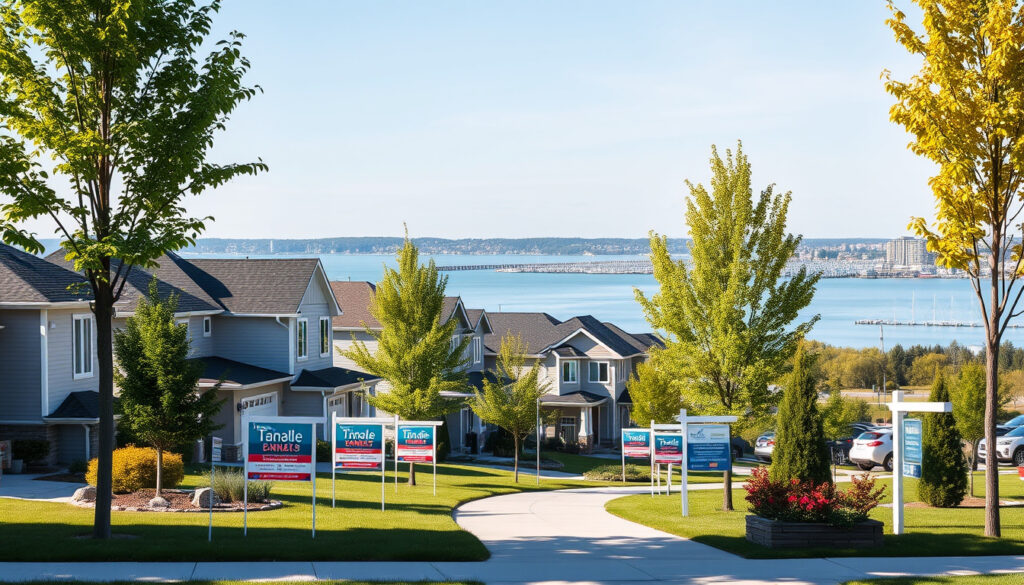
Houses for Sale in Burlington ON – 1,269 Listings $1.1M
Burlington, Ontario used to fly under the radar as Hamilton’s quieter neighbour. Not anymore. The city’s proximity to the GO train corridor and its top-rated schools have pushed it squarely into the premium tier of Greater Toronto Area markets, with the average home now trading near $1.1 million.
Houses for sale: 1,269 (REALTOR.ca) · Average home price: $1.1 million (March 2026) · Price change: up 2.7%
Quick snapshot
- Average sold price hit $1,098,789 in March 2026 (WOWA.ca)
- Sale-to-list ratio settled at 97% in April 2026 (Urban Group)
- Whether national immigration policy shifts will reshape demand in the 12-month horizon
- How specific neighbourhoods will diverge from the broader city-wide trend in 2026
- 757 new listings entered the market in the 28 days through early April 2026 (Urban Group)
- February 2026 sales climbed to 118 transactions from 98 in January (Market Update)
- RE/MAX forecasts a 2% price increase for Hamilton-Burlington going into 2026 (RE/MAX Blog)
- Move-up buyers continue driving demand in the detached segment (RE/MAX Blog)
| Metric | Value | Source |
|---|---|---|
| Total listings (REALTOR.ca) | 1,269 | WOWA.ca |
| Average price March 2026 | $1,098,789 | WOWA.ca |
| Detached homes | $1,430,212 | WOWA.ca |
| Condo apartments | $654,998 | WOWA.ca |
| Sale-to-list ratio | 97% | Urban Group |
| Median days on market | 27 days | Urban Group |
| HPI benchmark price (Feb 2026) | $890,300 | Cornerstone Real Estate |
| Bank of Canada rate | 2.25% (held Jan 28, 2026) | The Martin Group |
How much will Burlington Homes cost in 2026?
The headline figure: Burlington’s average sold price reached $1,098,789 in March 2026, a 2.7% uptick from the prior period, according to WOWA.ca. Early April data from Urban Group shows that momentum carried through, with the citywide average at $1,084,940—a 5% year-over-year gain.
Property-type segmentation tells a sharper story. Detached homes commanded $1,430,212 in March 2026, driven partly by move-up buyers who traded pandemic-era condos for more yard space, a cohort that added roughly 10% to the detached segment, per Urban Group. Meanwhile, condo apartments averaged $654,998—a more accessible entry point for first-timers.
March 2026 price breakdown by property type shows the full spectrum of options available in the Burlington market.
| Property type | Average price (March 2026) | Source |
|---|---|---|
| Detached | $1,430,212 | WOWA.ca |
| Semi-detached | $896,458 | WOWA.ca |
| Townhouse | $897,986 | WOWA.ca |
| Condo townhouse | $779,138 | WOWA.ca |
| Condo apartment | $654,998 | WOWA.ca |
Buyers with a $650,000 budget can still find a foothold—condos are running roughly half the detached average. First-time buyers targeting the $780,000–$920,000 sweet spot should focus on townhouses and entry-level semis, where supply is more generous.
Price movement in 2026 is expected to be modest and highly neighbourhood-specific rather than broadly increasing or decreasing, according to Urban Group. The implication: a detached home in Roseland may appreciate differently than an identical unit in Alton Village.
Burlington home prices jump 2.7 per cent to $1.1 million in March 2026
The 2.7% citywide increase aligns with broader Hamilton-Burlington forecasts from RE/MAX Blog, which projects a 2% price gain for the region going into 2026 compared to 2025. That year-over-year growth comes after the Hamilton-Burlington average dipped to $783,254 in 2025 from $810,074 in 2024, a 3% correction, per RE/MAX Blog.
Detached home prices declined approximately $214,000 year-over-year from January 2025 ($1,532,000) to January 2026 ($1,318,000), then recovered roughly $50,000 month-over-month into February, per market analysis. That volatility makes neighbourhood-level data more useful than citywide averages when timing a purchase or sale.
Is Burlington an expensive place to live?
By GTA standards, yes—but the city earns its price tag for certain buyer profiles. The Urban Group notes that Burlington’s proximity to the GO train corridor and its high-ranking schools make it more resilient to downturns than outlying suburbs. That resilience shows in the numbers: the sale-to-list ratio held at 97% as of April 2026, meaning accurately priced homes still attract competitive offers.
The Bank of Canada held its policy rate at 2.25% on January 28, 2026, per The Martin Group. That relatively stable borrowing cost has kept move-up and retiree buyers active, targeting the $1.3M–$1.6M and $800K–$900K brackets respectively, according to RE/MAX Blog.
Burlington ranked fifth best place to live on 2024 list of communities
Burlington has consistently placed near the top of livability rankings, a factor that underpins demand even when broader GTA markets soften. The city’s balance of transit access, green space, and community amenities keeps it attractive to families and remote workers who can afford the premium.
Buyers on a tight budget should note that inventory in the under-$500,000 range is thin. Condo apartments and condo townhouses offer the most realistic path to homeownership at that price point, though HOA-style fees add to the monthly cost of ownership.
What is the hardest month to sell a house?
Market timing matters in Burlington, though the city’s stable demand softens seasonal swings compared to colder or more volatile markets. The data shows that correctly priced homes are moving in a median of 27 days as of April 2026, per Urban Group. Overpriced listings, by contrast, languish for 45 or more days—a stark penalty for mispricing.
February 2026 data from market tracking shows sales climbed to 118 transactions from 98 in January, while inventory expanded from 424 to 485 homes. That spring uptick aligns with broader seasonal patterns: more listings and more buyers emerge as weather improves and the school-year calendar resets.
Best and Worst Times to Sell a House
Historically, the hardest months to sell fall in the late-fall and winter window—November through February—when holiday disruptions and cold weather keep buyers indoors and inventory sits longer. The Burlington market’s relative resilience (97% sale-to-list ratio in April 2026) suggests the seasonal effect is muted but not absent.
- Best windows: March through June aligns with increased buyer activity and fresh inventory.
- Hardest months: December through January typically see the longest days-on-market.
- The exception: Desperate sellers in December can sometimes find highly motivated buyers willing to close quickly.
The pattern holds: spring listing windows consistently outperform winter listings in Burlington’s data-driven market.
What devalues a house the most?
Several factors can shave tens of thousands from a Burlington home’s market value, regardless of neighbourhood appeal. The most common devaluation triggers fall into structural, cosmetic, and locational categories.
What Devalues a House the Most? | Common Property Issues Explained
- Deferred maintenance: Roofs nearing end of life, outdated electrical or plumbing, and visible water damage signal costly future repairs to buyers.
- Kitchen and bathroom datedness: Homes with 1990s-era kitchens often appraise below comparable renovated units by $50,000 or more in Burlington’s competitive market.
- Curb appeal deficits: Overgrown landscaping, cracking driveways, and peeling paint create a negative first impression that translates to lower offers.
- Noise or proximity issues: Homes backing onto the QEW or GO train corridor trade at a discount to interior lots, even in desirable neighbourhoods.
- Legal or zoning complications: Basement apartments without proper permits, encroachments, or easements can kill transactions outright.
The catch: in Burlington’s current market, where accurately priced homes move in 27 days, a property with visible devaluation issues faces a much steeper climb. Buyers in the $1.1M+ bracket are sophisticated enough to negotiate inspections down—or walk away entirely.
What are some red flags when selling?
Sellers entering the Burlington market need to watch for signals that can derail a transaction or crater a sale price. These warnings apply to both listing agents and homeowners managing the process independently.
Red Flags in Selling – The Sales Experts
- Overpricing based on neighbours’ aspirational asking prices: In Burlington’s neighbourhood-specific market, comparable sales data matters more than what a similar home is listed for.
- Ignoring pre-listing inspection findings: Unresolved structural or mechanical issues discovered late in negotiations can restart the entire negotiation cycle.
- Poor listing photos and descriptions: With 1,269 active listings competing for buyer attention on REALTOR.ca, Zillow, and Zolo, a below-average presentation pushes homes into the ignored pile.
- Refusing reasonable offers during a soft period: Holding out for a bidding war that never materialises risks days-on-market accumulating, which creates a stigma that future showings inherit.
- Overlooking closing cost obligations: Land transfer tax, legal fees, and realtor commissions add up to roughly 2–4% of the sale price and can surprise unprepared sellers at closing.
Burlington’s 97% sale-to-list ratio rewards sellers who price within 3% of fair market value. Overreaching—holding out for the last dollar—often costs more in carrying costs (mortgage, taxes, utilities) than the premium sought. The math shifts decisively in favour of the patient seller.
Upsides
- GO train access and top schools drive resilient demand
- Condo segment offers entry points under $700K for first-timers
- Sale-to-list ratio at 97% reflects a healthy, stable market
- RE/MAX forecasts 2% price growth for 2026
Downsides
- Detached average near $1.43M limits options for stretch buyers
- Overpriced listings sit 45+ days—mispricing has real consequences
- Under-$500K inventory is thin; condo fees add to ownership costs
- Year-over-year detached price volatility near $214K swing
How to sell a house in Burlington: a step-by-step guide
Selling a home in Burlington’s 2026 market requires a different playbook than the frenzied 2021–2022 era. Here’s how to approach it strategically.
- Pull your comps by neighbourhood, not citywide average. Roseland, Alton Village, and Brant Hills trade differently. Use HPI benchmark data ($890,300 citywide in February 2026) as a baseline, then adjust for your specific street and property type.
- Get a pre-listing inspection. In a market where buyers negotiate hard on inspection findings, surfacing issues before listing lets you price accordingly or make targeted repairs that protect your sale price.
- Price within 3% of fair market value on day one. With median days on market at 27, overpricing immediately signals weakness. The window for correction narrows fast.
- Stage for the right buyer segment. If you’re selling a detached, appeal to move-up families ($1.3M–$1.6M budget). If it’s a condo, play up transit access and the entry-level price advantage.
- List during the spring window if possible. March through June captures the highest buyer activity. December through January should be avoided unless circumstances demand a quick close.
- Negotiate with the 97% sale-to-list ratio in mind. Buyers expect a modest negotiation cushion (roughly 3%). Holding firm beyond that risks losing the deal, not gaining a better one.
The implication: Burlington sellers who follow this roadmap—accurate pricing, thoughtful staging, spring listing—consistently close in under 30 days. The 97% sale-to-list ratio is the market’s signal that fair pricing wins.
Related reading: Nova Scotia Real Estate: Cheap Homes, MLS & Rentals · Things to Do in London Ontario – Parks Museums Family Fun
Frequently asked questions
How much will Burlington homes cost in 2026?
The average sold price reached $1,098,789 in March 2026, with detached homes averaging $1,430,212 and condos around $654,998. RE/MAX forecasts a modest 2% price increase for the Hamilton-Burlington region going into 2026, per RE/MAX Blog.
Is Burlington an expensive place to live?
Yes, by Canadian standards—Burlington’s average home price of $1.1 million places it in the premium tier of GTA markets. However, its GO train access, high-ranking schools, and strong livability rankings (fifth best community in 2024) justify the premium for buyers who can afford it. Condo options under $700K offer a more accessible entry point.
Will property prices drop in 2026?
Citywide, prices are expected to remain stable with modest upward movement. The HPI benchmark was $890,300 in February 2026, and the RE/MAX forecast calls for 2% growth in average residential sale prices going into 2026. However, specific neighbourhoods may diverge from the citywide trend, particularly if buyer demand for detached homes continues to surge.
What is the hardest month to sell a house?
Historically, December and January are the slowest months in Burlington, with longer days on market. The spring window from March through June captures the highest buyer activity and shortest time-to-sale. Overpriced listings that sit beyond 45 days face a compounding stigma effect that further reduces final sale price.
What devalues a house the most?
Deferred maintenance (roof, plumbing, electrical), dated kitchens and bathrooms, poor curb appeal, proximity to noise sources like the QEW or GO corridor, and legal complications such as unpermitted basement units can each shave $30,000 to $100,000 or more from a home’s appraised value in Burlington’s market.
What are some red flags when selling?
Overpricing relative to actual comparable sales, refusing to address pre-listing inspection findings, poor listing photography, holding out for a bidding war in a market where the sale-to-list ratio is 97%, and underestimating closing costs are the most common seller mistakes that delay or derail transactions in Burlington.
How many houses are for sale in Burlington?
Approximately 1,269 homes were listed on REALTOR.ca as of early 2026, with additional inventory on Zillow (719 homes) and Zolo (950 homes). New listings have been entering at a pace of roughly 757 in the 28-day window through early April 2026.
For buyers, the takeaway is straightforward: Burlington’s premium pricing reflects genuine quality of life factors—transit, schools, and neighbourhood stability—that aren’t going away. Waiting on the sidelines for a crash that the data doesn’t support means paying more later. For sellers, the market rewards accuracy and preparation over optimism. Price your home against real comps, not wishful thinking, and close in under a month.
More related posts
 William Cloutier: Biography, Career, Songs, and Personal Life
 Kevin Spacey: Oscar Winner to Allegations Fallout
 One Life (2023 Film) – Nicholas Winton True Story & Cast
 Craig Kielburger Secondary School – Milton High School Overview
 Lord of the Rings Characters – Alphabetical List with Actors
 Atlético Madrid vs Real Madrid Statistics: H2H Wins & Records
 Money in the Bank 2025: Date, Time, Venue, How to Watch on Netflix
 Team Canada World Juniors 2026: Roster, Losses & Elimination